If you’re a desk worker feeling stiff and disconnected from your body, the solution isn’t just more exercise; it’s smarter movement. Functional training is about rediscovering your body’s ‘primal blueprints’—innate patterns like squatting, carrying, and balancing. This guide moves beyond generic gym routines to teach you why these specific movements are the key to undoing the ‘digital slouch,’ building practical strength, and ensuring your body is resilient for the demands of daily life, not just for the gym.
The subtle ache in your lower back after a long day. The stiffness in your hips when you stand up. The nagging feeling that your body is becoming less capable, a little more foreign. For many desk workers between 30 and 50, this is a daily reality. The common advice is to « stretch more » or « hit the gym, » but these solutions often feel disconnected from the real problem. You might follow a routine, but does it actually help you carry groceries, play with your kids, or simply sit and stand without discomfort?
The issue isn’t a lack of effort, but a misunderstanding of the goal. Most modern fitness focuses on isolating muscles, but daily life demands that our bodies work as an integrated system. The stiffness and weakness you feel are symptoms of a modern lifestyle that has caused us to forget our own movement vocabulary. We’ve traded deep squats for office chairs, heavy carries for desk work, and dynamic balance for static sitting. As the average American sits for more than 11 hours a day, our bodies adapt to this inactivity, losing the very capabilities that define functional, pain-free movement.
But what if the key wasn’t to learn dozens of new, complicated exercises, but to remember how your body is fundamentally designed to move? This is the core of functional training. It’s not about aesthetics; it’s about reclaiming your primal blueprints. It’s a return to the foundational human movements that build a body resilient for real life. This isn’t just for elite athletes; it’s for anyone who wants to feel strong, mobile, and confident in their everyday activities.
This guide will walk you through the essential functional movements that directly combat the effects of a sedentary job. We won’t just tell you what to do; we will explain the ‘why’ behind each movement, showing you how to rebuild your body from the ground up to improve mobility and ensure long-term health.
Summary: Functional Training for Everyday Strength and Mobility
- The Third World Squat: Why Can’t You Sit Deeply and How to Fix It?
- Farmer’s Walks: How Carrying Heavy Weights Improves Posture and Grip Strength?
- Single-Leg Deadlifts: Why Training One Side at a Time Fixes Imbalances?
- Bear Crawls: Why This Primal Movement Is the Ultimate Core Workout?
- Prehab Routine: The 5 Movements You Must Do Before You Turn 40
- Face Pulls: The One Exercise You Need to Undo Slouching Shoulders
- Dynamic Hip Flexor Stretches: Essential Prep to Avoid Hamstring Tears
- How to Improve Spinal Alignment for Better Posture and Reduced Back Pain?
The Third World Squat: Why Can’t You Sit Deeply and How to Fix It?
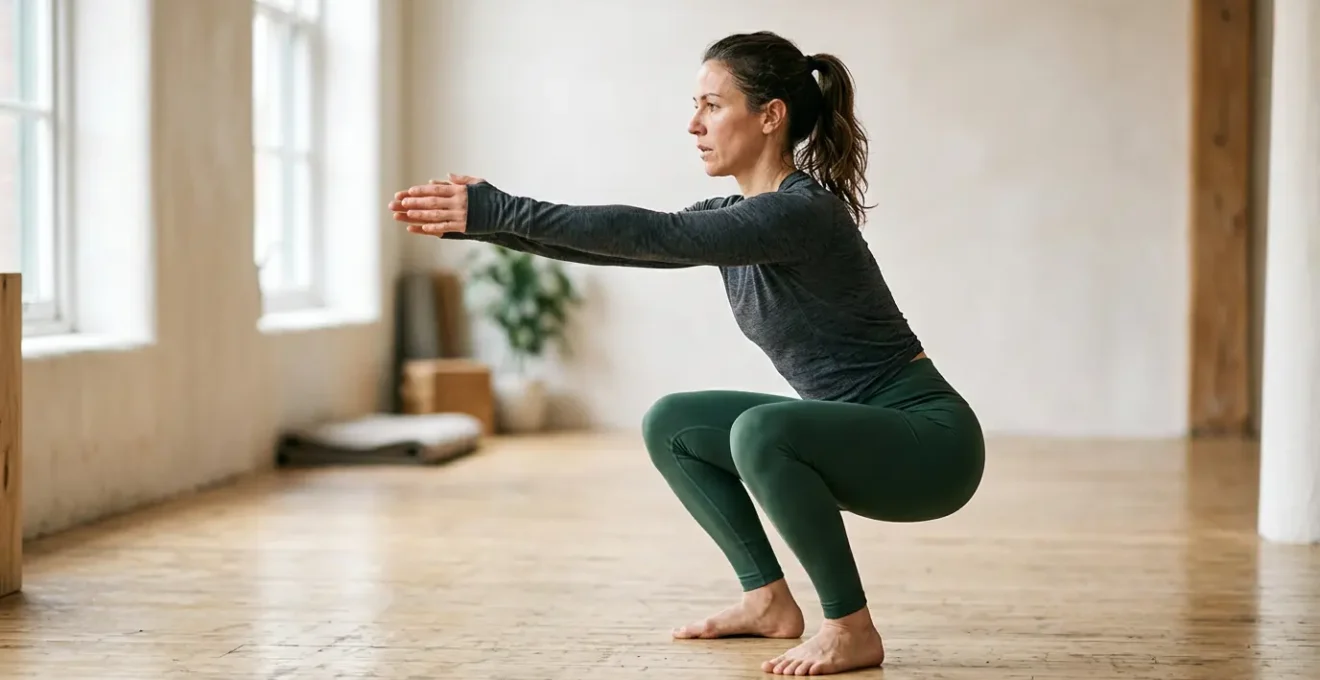
The ability to sit in a deep squat, with your heels on the ground and hips below your knees, is not an advanced yoga pose; it’s a fundamental human resting position. Often called the ‘third world squat’ or resting squat, it’s a primal blueprint our bodies are built for. For a desk worker, however, years of sitting in chairs have effectively ‘un-taught’ us this pattern. Chairs shorten hip flexors, deactivate glutes, and, most critically, limit ankle mobility. When you can’t squat deep, it’s often because your ankles lack the necessary range of motion (dorsiflexion) to allow your knees to track forward over your toes without your heels lifting up.
This loss of mobility has a cascading effect throughout your kinetic chain, contributing to knee pain and lower back stress during everyday activities like picking something up off the floor. Reclaiming your deep squat is about more than just a single exercise; it’s about restoring a foundational pillar of human movement. The journey starts not with your hips, but from the ground up, with your ankles.
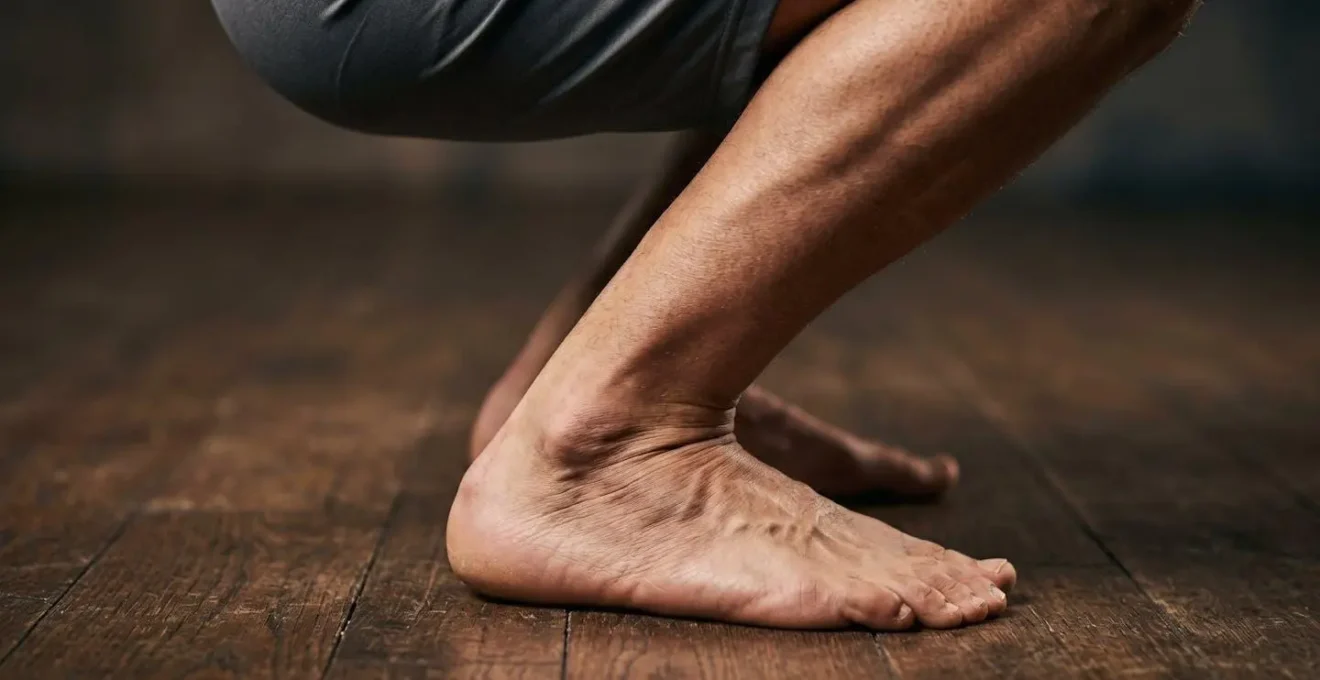
As this image illustrates, achieving a deep squat is impossible without adequate ankle flexibility. The goal is to improve the ability of your shin to move towards your foot, which unlocks the entire movement. You can start by practicing passive squat holds, holding onto a doorframe for support, and letting gravity do the work. The aim is to re-familiarize your nervous system with this position, gently encouraging your joints to regain their natural movement vocabulary.
Gradually, by focusing on ankle mobility drills and consistent practice, you can reclaim this essential human movement, improving your overall mobility and reducing the strain on your body during daily tasks.
Farmer’s Walks: How Carrying Heavy Weights Improves Posture and Grip Strength?
One of the most functional movements imaginable is carrying a heavy object. From bringing in groceries to moving furniture, the ability to maintain posture under load is a real-life necessity. The Farmer’s Walk, which involves simply walking while holding heavy weights (like dumbbells or kettlebells) at your sides, directly trains this skill. It’s a full-body exercise that forces your core to stabilize, your upper back to resist slouching, and your shoulders to remain packed and stable.
For the desk-bound body, this exercise is a powerful antidote to the ‘digital slouch’. It actively corrects posture by forcing you to engage the very muscles that become weak and elongated from sitting. But the benefits go even deeper. The Farmer’s Walk is one of the best ways to develop grip strength, which is far more than just the ability to hold on tight. It is a surprisingly accurate indicator of overall health and longevity.
In fact, grip strength is so crucial that it’s used as a clinical marker for predicting future health outcomes. A landmark 2024 study in *Scientific Reports* found that participants with the weakest grip strength had a significantly higher mortality risk. Specifically, the data showed 2.20 to 2.52 times higher mortality risk for those in the lowest quintile of grip strength. This highlights that a strong grip is a proxy for overall systemic strength and resilience.
Incorporating Farmer’s Walks into your routine is straightforward. Start with a weight that challenges you but allows you to maintain an upright posture for 30-60 seconds. You are not just building muscle; you are building a more robust, resilient body for life.
Single-Leg Deadlifts: Why Training One Side at a Time Fixes Imbalances?
Most of our daily life is spent on one leg, whether we realize it or not. Walking, climbing stairs, and even just shifting our weight are all unilateral (single-sided) activities. Yet, in the gym, we often default to bilateral exercises like traditional squats and deadlifts. This can mask or even worsen strength imbalances between our left and right sides, a common issue for anyone who, for example, always carries a bag on the same shoulder.
The Single-Leg Deadlift is the perfect tool to address this. By training one leg at a time, you force the smaller stabilizing muscles in your hips, ankles, and core to fire up and work overtime to maintain balance. This develops proprioception—your body’s awareness of its position in space. As one expert source puts it:
Because it is performed on one leg, the bodyweight single leg deadlift significantly challenges balance and proprioception. The stabilizing muscles around the hips, ankles, and core must work continuously to maintain alignment and control.
– Exercise Library, Bodyweight Single Leg Deadlift technique guide
This enhanced body awareness translates directly to fewer injuries and better coordination in everyday life. For instance, a study found that athletes performing single-leg deadlifts had a 66% lower risk of hamstring strains, a common injury often caused by muscular imbalances and poor glute activation. By strengthening each leg independently, you ensure your body doesn’t develop faulty compensation patterns that lead to pain and injury down the line.
You don’t need heavy weight to start. Begin with just your bodyweight, focusing on a slow, controlled hinge at the hips while keeping your back flat. This simple movement is a profound investment in long-term joint health and stability.
Bear Crawls: Why This Primal Movement Is the Ultimate Core Workout?
When we think of ‘core work,’ we often picture crunches and planks. But a truly functional core isn’t just about abdominal strength; it’s about 360-degree stability and the ability to coordinate the upper and lower body. The Bear Crawl, a seemingly simple quadrupedal (on all fours) movement, is a primal blueprint that re-teaches this essential connection. It challenges your body in a way few other exercises can.
Crawling forces you to stabilize your spine in a horizontal plane while moving your opposite arm and leg in unison. This cross-lateral pattern is fundamental to human locomotion (like walking and running) and is excellent for neurological re-patterning. It builds shoulder stability, hip mobility, and a rock-solid core all at once. For a desk worker, it’s a direct antidote to the disconnected feeling that comes from sitting all day, waking up the link between your shoulders and hips.
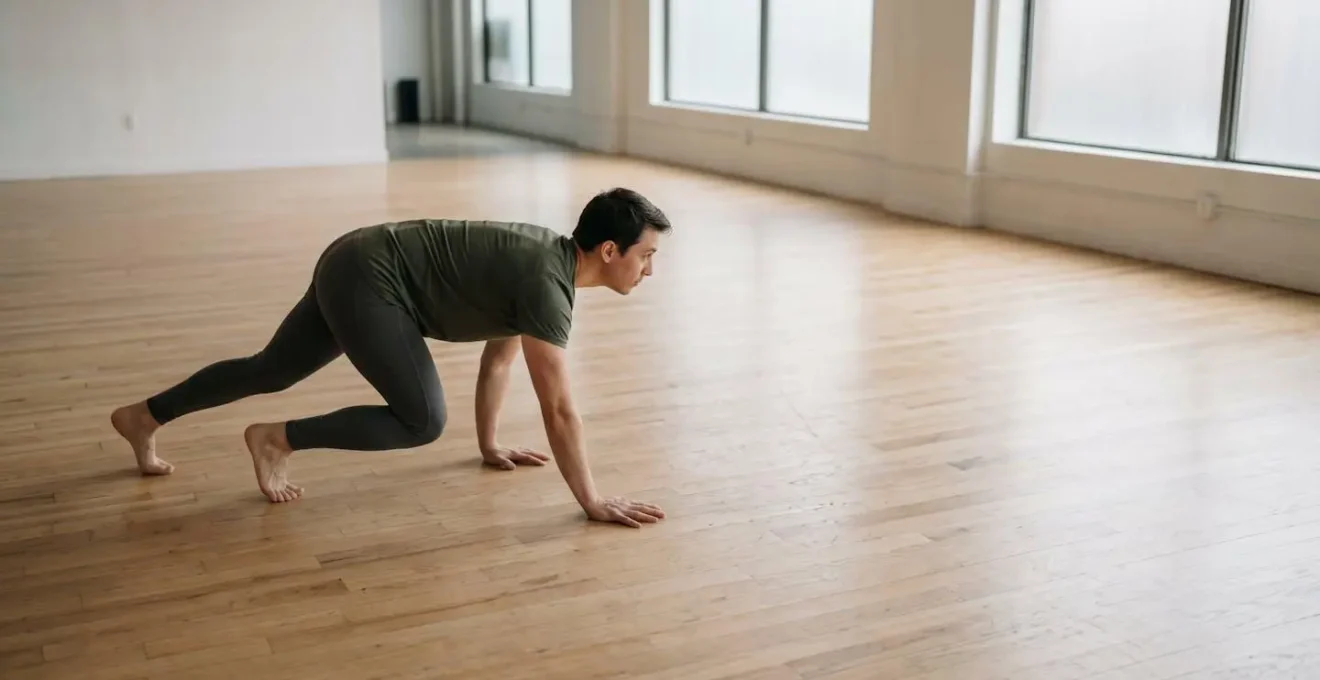
This exercise does more than just build strength. It re-engages deep core muscles that support your spine and pelvis. The benefits are not just theoretical; a 2024 study found that quadrupedal movements offer superior cardiovascular benefits and physical function improvements for adults compared to simple walking. It is a low-impact, high-reward movement that should be a staple in any functional training program.
To perform a bear crawl, get on all fours with your hands under your shoulders and knees under your hips, then lift your knees just an inch or two off the ground. Keep your back flat and core tight as you slowly move one hand and the opposite foot forward a few inches. The key is to move slowly and with control, not for speed.
Prehab Routine: The 5 Movements You Must Do Before You Turn 40
As we age, proactive « prehabilitation » becomes more important than reactive rehabilitation. For those of us spending our days at a desk, certain joints—namely the mid-back (thoracic spine), hips, and shoulders—are particularly vulnerable to stiffness and dysfunction. A targeted prehab routine isn’t about exhausting yourself; it’s about performing specific, controlled movements that maintain joint health and prevent problems before they start. These are the non-negotiables for counteracting the effects of a sedentary job.
Think of this routine as daily maintenance for your body’s hardware. These movements focus on rotation, full-range-of-motion control, and activation of key stabilizing muscles. They address the common culprits behind the ‘digital slouch’ and lower back pain. For example, Thoracic Spine Rotations directly combat the stiffness from hunching over a keyboard, while Glute Bridges wake up the powerful hip muscles that sitting deactivates. This isn’t just stretching; it’s a conversation with your nervous system, reminding it of its full movement potential.
Integrating a few key prehab movements into your warm-up or even as short breaks throughout the day can dramatically improve your long-term mobility and reduce your risk of injury. It’s an investment that pays dividends for decades, ensuring you enter your 40s and beyond feeling capable and resilient, not stiff and fragile.
Action Plan: Your Pre-40 Mobility Audit
- Points of contact (Identify problem areas): List all the ‘stiff signals’ your body sends during a typical workday: tight hips from sitting, rounded shoulders from typing, or a sore lower back.
- Collect (Inventory current movements): Inventory your existing mobility habits. Do you stretch? Foam roll? Note what you do, how often, and if it provides relief.
- Coherence (Check against fundamentals): Confront your routine with the 5 fundamental prehab movements. Does it cover thoracic rotation, hip mobility, ankle dorsiflexion, scapular stability, and glute activation?
- Memorability/emotion (Find your anchor): Identify the one movement that feels most ‘unlocking’ or relieving. This is your priority movement to build a consistent habit around.
- Plan of integration (Schedule the fix): Create a simple plan to fill the gaps. Schedule 5 minutes of Hip CARs before your workout, or 10 Thoracic Rotations every time you stand up from your desk.
By making these movements a consistent part of your routine, you are actively future-proofing your body against the wear and tear of modern life.
Face Pulls: The One Exercise You Need to Undo Slouching Shoulders
Years of typing, texting, and looking down at screens create a predictable postural problem known as Upper Cross Syndrome. This is characterized by tight chest muscles and weak, overstretched upper back muscles, resulting in rounded, slouching shoulders and a forward-head posture. While many exercises can contribute to better posture, the Face Pull is arguably the single most effective movement for directly targeting and reversing this pattern.
The Face Pull, typically performed with a cable machine or resistance band, strengthens the weak muscles of the upper back—the rear deltoids, rhomboids, and external rotators of the shoulder. These are the exact muscles responsible for pulling your shoulder blades back and down, creating an upright, open posture. It’s a direct counter-movement to the daily hunch.

The importance of this kind of targeted strengthening cannot be overstated. As the BarBend research team notes, strong and stable shoulders are fundamental to overall function:
Without shoulder stability, your risk of injury, pain, and limited mobility can increase. Studies suggest that performing shoulder stability exercises can help increase range of motion, shoulder strength, grip strength, and can help prevent shoulder joint damage.
– BarBend Research Team, Bear Crawl shoulder stability benefits
By consistently performing face pulls, you are not just improving your appearance; you are restoring proper mechanics to the shoulder joint, reducing the risk of impingement and pain. It’s a targeted strike against the most visible and damaging postural effect of a desk job.
Focus on light weight and perfect form: pull the band or rope towards your face, aiming to get your hands higher than your elbows, and squeeze your shoulder blades together at the end of the movement. It’s a humbling exercise that pays huge dividends in postural health.
Dynamic Hip Flexor Stretches: Essential Prep to Avoid Hamstring Tears
For many active individuals, tight hamstrings are a constant complaint. We stretch them, we foam roll them, but they always seem to tighten up again. The reason often has little to do with the hamstrings themselves and everything to do with their opposing muscles: the hip flexors. Hours of sitting in a chair leaves the hip flexors in a shortened, chronically tight state. This creates a neurological imbalance known as reciprocal inhibition.
In simple terms, when one muscle group is overly tight (the hip flexors), it sends a signal to the brain that can neurologically ‘turn down’ the activation of its opposing muscle group (the glutes). When your powerful glute muscles don’t fire properly during movements like running or lifting, your hamstrings are forced to pick up the slack and overwork. This compensation pattern is a primary driver of hamstring strains and tears. The real solution, therefore, is not to endlessly stretch the victim (the hamstrings), but to address the culprit (the tight hip flexors).
However, the key is to use dynamic, not static, stretches before a workout. Static stretching can temporarily reduce power output. Dynamic movements like leg swings, walking knee hugs, and rocking lunges are far more effective. They signal to your nervous system that you are preparing for movement, increasing blood flow and improving mobility without compromising strength. By opening up the hips, you allow the glutes to activate properly, taking the excessive burden off your hamstrings.
Before your next workout, swap your long-hold hamstring stretch for a few sets of forward and side-to-side leg swings. You’ll be addressing the root cause of the problem, leading to better performance and a significantly lower risk of injury.
Key takeaways
- Reclaiming the deep squat is a fundamental skill for hip and ankle health, often limited by modern lifestyles.
- Grip strength, effectively trained by Farmer’s Walks, is a powerful and scientifically-backed predictor of longevity and overall health.
- Unilateral (single-leg) exercises are essential for correcting strength imbalances and improving proprioception, reducing injury risk.
- Primal movements like Bear Crawls rebuild core stability and the crucial mind-body connection lost to sedentary habits.
How to Improve Spinal Alignment for Better Posture and Reduced Back Pain?
Great posture isn’t about rigidly holding your shoulders back; it’s the dynamic result of a well-aligned spine supported by a functional core. For desk workers, the battle for good posture is won or lost in the small details of daily life. Improving spinal alignment requires a two-pronged approach: strengthening the core that supports it and integrating small, consistent postural cues into your everyday routine.
A strong core acts like a natural corset for your spine, providing 360-degree support. As research indicates that core stability is important for standing, sitting, walking, and maintaining balance, it is the bedrock of good posture. Exercises like the Bear Crawl and Plank are excellent, but true spinal alignment also depends on how you breathe. Deep, diaphragmatic « 360 breathing »—where you expand your belly, sides, and back—pressurizes your core and provides stability from the inside out.
Beyond formal exercise, you can « grease the groove » of good posture by weaving micro-habits into your day. These small adjustments re-train your nervous system to prefer better alignment. Instead of one big effort, it’s about hundreds of small corrections. Here are a few powerful examples:
- The Doorway Check: Every time you walk through a doorway, quickly check your alignment: are your ears stacked over your shoulders, and your ribcage over your pelvis?
- Red Light Chin Tucks: While driving, use red lights as a cue to practice chin tucks, gently pulling your head back to align your ears with your shoulders.
- Ribs Down Cue: Throughout the day, become aware of your lower back. If you’re over-arching, gently cue yourself to pull your ‘ribs down’ toward your hips.
By combining targeted core work with these conscious, daily micro-habits, you can systematically improve your spinal alignment, reduce back pain, and build a posture that is effortlessly strong and upright.