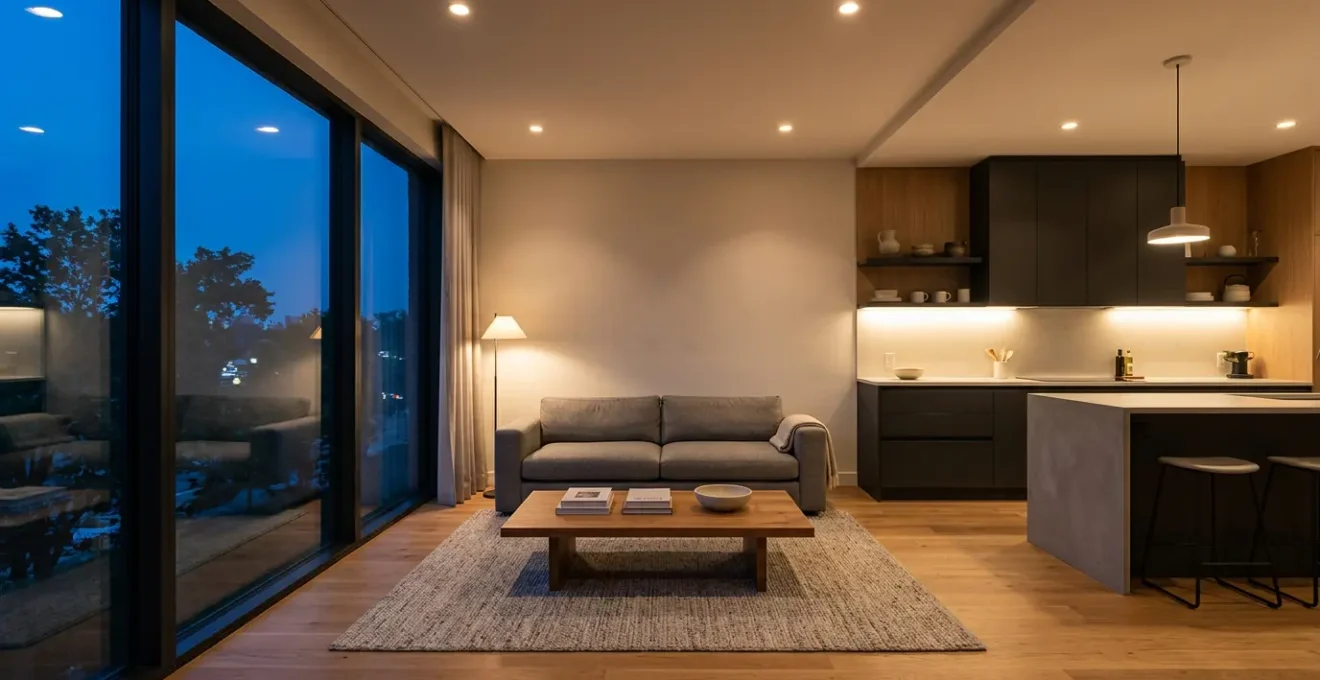
Upgrading to smart lighting is less about the tech and more about becoming the architect of your home’s atmosphere and efficiency.
- Prioritize lumens for brightness, not watts, to accurately gauge light output.
- Understand the Kelvin scale to strategically influence mood, productivity, and sleep cycles.
- Master wiring basics, like identifying a neutral wire, for seamless smart switch integration.
Recommendation: The goal isn’t just automation; it’s designing a lighting system that actively enhances how you live, work, and relax in your space.
As a smart home electrician, I see many tech enthusiasts jump into smart lighting, excited by the promise of voice control and colorful scenes. They buy the latest bulbs and switches, but often the result feels more like a collection of gadgets than a truly intelligent system. The common advice focuses on pairing devices with Alexa or Google Home, but this approach misses the bigger picture entirely. The real magic isn’t just telling your lights to turn on; it’s designing a system that anticipates your needs and enhances your environment without a single command.
The mistake is thinking about installation as a simple task of replacing hardware. We’re bombarded with options: smart bulbs, smart switches, LED strips, motion sensors. But without a foundational understanding of how light and electricity work together, you’re just decorating with technology. You might end up with a living room that’s too bright, a kitchen with unflattering light, or a system that’s confusing to operate.
This guide takes a different approach. We won’t just cover the « how-to » of installation. We will delve into the « why » behind each decision. The true key to a successful smart lighting project lies not in the products you buy, but in mastering the core principles of light and power. By understanding concepts like lumen density, the Kelvin scale’s effect on your biology, and the electrical requirements of your home, you shift from being a simple installer to a thoughtful lighting designer.
Throughout this article, we’ll break down these foundational concepts. You’ll learn how to choose the right brightness and color temperature for each room’s function, understand the wiring in your walls to select the right components, and place sensors strategically to create a home that responds to you. The goal is to empower you to build a cohesive, efficient, and genuinely convenient lighting system that adds real value to your home.
Summary: A Complete Guide to Designing and Installing Smart LED Lighting
- Lumens vs Watts: How to Choose the Right Brightness for LED Bulbs?
- Neutral Wire: Do You Need It to Install Smart Light Switches?
- Kelvin Scale: Why Should You Use 2700K in the Bedroom and 4000K in the Kitchen?
- LED Strips: How to Cut and Connect Them for Under-Cabinet Lighting?
- Motion Sensors: Where to Place Them so Lights Turn On When You Enter?
- Kitchen Cabinet Painting: How to Get a Factory Finish with a Roller?
- Password Managers: Is It Safe to Store All Your Logins in One Cloud Vault?
- How to Plan Creative DIY Home Improvement Projects That Add Real Value?
Lumens vs Watts: How to Choose the Right Brightness for LED Bulbs?
The first and most fundamental shift in thinking when moving to LED lighting is to stop talking about Watts and start focusing on lumens. For decades, we associated the brightness of an incandescent bulb with its wattage (e.g., 60W, 100W). However, wattage measures energy consumption, not light output. With the incredible efficiency of LEDs, this old habit is misleading. An LED bulb can produce the same amount of light as a 60W incandescent while consuming only 8-12 watts of power.
This efficiency is the primary driver of energy savings. Modern LEDs use up to 75% less energy and last 25 times longer than their incandescent counterparts. Therefore, when you’re at the store, the lumen rating is the only number that tells you the truth about a bulb’s brightness. A higher lumen count means more light. This allows you to design your lighting with precision, ensuring a space is neither under-lit nor overpoweringly bright.

As you can see, the perceived brightness is a direct result of the light output, not the energy consumed. To make the transition easier, you can use a simple conversion chart as a starting point. This helps translate your old understanding of wattage into the new language of lumens.
This table clearly shows the disparity in energy use. A 100W incandescent that produces 1,600 lumens can be replaced with a 16-20W LED, a massive reduction in power for the same level of brightness. This is the core of your energy savings strategy.
| Incandescent Watts | Approximate Lumens | LED Equivalent Watts | Brightness Level |
|---|---|---|---|
| 40W | 450 lumens | 6-9W | Soft ambient lighting |
| 60W | 800 lumens | 8-12W | Standard room lighting |
| 75W | 1,100 lumens | 12-15W | Bright task lighting |
| 100W | 1,600 lumens | 16-20W | Very bright lighting |
Ultimately, choosing the right brightness is about matching the light output to the function of the space. A reading nook requires more focused lumens than a hallway, and by understanding this, you begin to design with intent rather than by habit.
Neutral Wire: Do You Need It to Install Smart Light Switches?
This is one of the most common—and critical—technical hurdles in a smart lighting installation. A neutral wire is a type of electrical wire that completes the circuit, allowing a continuous flow of a small amount of power. Smart switches need this constant trickle of power to keep their « smart » components (like the Wi-Fi or Zigbee radio) online, even when the light fixture itself is turned off. Without it, the switch is just a dumb piece of plastic.
Whether your home has neutral wires in its switch boxes often depends on its age. Most homes built after the mid-1980s in the U.S. will have them, but older homes often do not. Before buying any smart switches, you must check your wiring. It’s a simple process, but always remember to turn off the power at the circuit breaker first. Then, remove the switch plate and look inside the box. If you see a bundle of two or more white wires capped together with a wire nut and not connected to the switch, you have a neutral wire. If you only see wires connected directly to the switch (typically a black, a white, and a green/bare ground wire), you likely don’t have a neutral.
But what if you don’t have one? You’re not out of luck. Manufacturers have developed « no-neutral » smart switches. These clever devices work by maintaining a tiny current that flows through the connected light fixture itself. This current is just enough to power the switch’s radio without being enough to make the bulb glow. However, this solution can sometimes cause issues with low-wattage LED bulbs, leading to a faint glow (ghosting) or flickering when off. It’s also important to remember never to mix smart bulbs with smart switches on the same circuit; this creates a conflict as both devices try to control the power, often leading to unpredictable behavior.
If you opt for a no-neutral switch and experience flickering, the fix is often to use a dimmable LED certified for smart use or to install a small bypass capacitor at the light fixture, which helps stabilize the load. Knowing about the neutral wire requirement beforehand saves immense frustration and allows you to choose the right hardware from the start.
In essence, checking for a neutral wire is the first diagnostic step in planning a robust, wall-controlled smart lighting system. It determines your path forward and ensures the solution you choose is compatible with your home’s electrical DNA.
Kelvin Scale: Why Should You Use 2700K in the Bedroom and 4000K in the Kitchen?
Once you’ve determined the right brightness (lumens), the next layer of design is choosing the right color of light. This is measured on the Kelvin (K) scale. It’s a common mistake to think of this as just an aesthetic choice between « yellow » and « blue » light. In reality, the color temperature of your lighting has a profound psychological and biological impact. This is the principle behind what we call circadian lighting—using light to support your body’s natural sleep-wake cycle.
Lower Kelvin values produce a warm, cozy, amber glow, similar to a sunset or a candle flame. Higher values produce a cool, crisp, bluish-white light that mimics bright daylight. Here’s a simple breakdown:
- 2700K (Warm White): This is the color of a traditional incandescent bulb. It’s relaxing, inviting, and intimate. It’s ideal for bedrooms, living rooms, and dens—spaces where you want to wind down.
- 4000K (Cool White): This light is bright and energizing. It enhances focus and color accuracy. It’s perfect for task-oriented spaces like kitchens, home offices, bathrooms, and garages, where you need to see clearly.
The science behind this is clear. As a Harvard study demonstrated, exposure to blue-enriched cool light in the evening can suppress melatonin production, the hormone that helps you sleep. This is why using a 4000K bulb in your bedroom at night can disrupt your rest, while a 2700K light helps your body prepare for sleep. This concept is at the heart of designing a human-centric smart home.

As the experts at the TrueLight Research Team emphasize, aligning your home’s lighting with natural cycles is key for well-being:
Light is one of the most influential inputs to your circadian rhythm. Ideally, you want to incorporate circadian lighting in your home or office that mimics the color temperature of the sun’s natural light as it progresses throughout the day.
– TrueLight Research Team, Kelvin Color Temperature Guide
With modern tunable-white smart bulbs, you can automate this. You can program your lights to be a crisp 4000K during the day for focus and then automatically shift to a warm 2700K in the evening to help you relax. This is where smart lighting transcends convenience and starts actively improving your quality of life.
LED Strips: How to Cut and Connect Them for Under-Cabinet Lighting?
LED strips are one of the most versatile tools in a smart lighting designer’s kit. They are perfect for task lighting under kitchen cabinets, creating ambient glow behind a TV, or adding architectural accents to a room. However, achieving a professional, clean look requires more than just peeling and sticking. The key lies in precise measurement, proper surface preparation, and understanding how to cut and connect the strips without damaging them.
First, the quality of light from an LED strip is determined by its lumen density, measured in LEDs per meter. Low-density strips (60 LEDs/meter or less) can create a « dotted » or « hotspot » effect, where you see individual points of light. For a smooth, continuous line of light, especially on reflective surfaces like granite countertops, always opt for high-density strips with 120 LEDs/meter or more. This is the secret to a high-end, factory-finish look. Premium strips also often feature a triple-LED design, allowing for full-color customization and adjustable brightness, giving you complete control over the scene.
The installation process itself must be meticulous. Don’t eyeball your measurements; use a tape measure and plan your cuts carefully. LED strips can only be cut at designated points, usually marked with a small scissor icon, typically every 2-3 inches. Cutting anywhere else will break the circuit and render that section useless. When it comes to connecting cut sections around corners, you have two options: solderless clips, which are convenient but can sometimes be unreliable, or soldering the connections, which is the professional standard for a secure, long-lasting bond.
Finally, adhesion is critical. The surface must be perfectly clean and smooth. Avoid trying to stick strips directly to painted drywall or textured surfaces, as they will eventually peel off. Clean the mounting area with a cloth and, for a truly permanent installation, consider mounting the strip inside a dedicated aluminum channel with a diffuser. This not only protects the strip but also softens the light for an even more polished result.
Action Plan: Achieving a Professional Under-Cabinet LED Strip Installation
- Measure the area: Use a tape measure for precision, adding a small margin. Plan where your cuts and connections will be.
- Prepare the surface: Clean the mounting surface thoroughly with a cloth. Ensure it is completely dry, smooth, and free of dust or grease for proper adhesion.
- Cut the strips: Only cut the LED strip at the designated copper cut marks. Always do this before peeling the adhesive backing.
- Connect the sections: For corners and gaps, use either solderless clip connectors or, for the most reliable connection, solder wires between the strip sections.
- Install and secure: Peel the adhesive backing gradually, pressing the strip firmly into place. Hold each section for at least 10 seconds to ensure a strong bond.
By focusing on these details—LED density, precise cuts, secure connections, and surface prep—you can elevate a simple DIY project into a stunning and functional design feature.
Motion Sensors: Where to Place Them so Lights Turn On When You Enter?
Motion sensors are what transform a smart lighting system from merely « remote-controlled » to truly « automated » and intelligent. The goal is to have lights turn on when you need them and off when you don’t, without ever touching a switch or speaking a command. This is especially useful in transitional spaces like hallways, laundry rooms, and entryways. However, effective automation depends entirely on choosing the right type of sensor and implementing a smart sensor strategy for placement.
There are two primary types of sensors used in smart homes, and they work very differently:
- PIR (Passive Infrared) Sensors: These are the most common and affordable. They work by detecting the heat signature of a moving object. They are excellent for areas where people are actively moving, like a hallway. Their main limitation is that they require motion; if you sit still in a room (like reading in an office), a PIR sensor will think you’ve left and turn the lights off.
- mmWave (Millimeter Wave) or Radar Sensors: These are a more advanced technology. They emit low-power radio waves and detect presence by sensing the tiny disturbances these waves encounter—even something as small as breathing. This means they can detect a stationary person, making them ideal for bathrooms, home offices, or living rooms where you might be sitting still for long periods.
The choice of sensor dictates its placement. A PIR sensor should be placed where it can « see » the main pathways of movement, like pointing down a hallway or across a doorway. An mmWave sensor can be placed more centrally in a room to cover the entire area. The technology is rapidly being adopted, as the 2024 Residential Energy Consumption Survey found that nearly 14 million U.S. households now use smart devices for lighting control, paving the way for more advanced sensor integration.
This table breaks down the key differences to help you choose the right technology for each room.
| Sensor Type | Detection Method | Best Use Case | Limitation | Typical Range |
|---|---|---|---|---|
| PIR (Passive Infrared) | Detects heat from moving objects | Hallways, entryways, areas with constant movement | Requires motion; turns off if you sit still | 15-25 feet |
| mmWave/Radar Occupancy | Detects presence via radio waves, even without movement | Home offices, bathrooms, reading areas where occupants remain stationary | More expensive; may need sensitivity adjustment | 20-30 feet |
| Dual Technology | Combines PIR + mmWave for accuracy | Multi-purpose rooms requiring maximum reliability | Highest cost option | 25-35 feet |
By strategically combining these sensor types, you can create a layered and highly reliable automation system. For example, use a PIR sensor at the entrance of a living room for instant-on activation, and an mmWave sensor within the room to keep the lights on while you’re watching a movie. This is the essence of designing for convenience.
Kitchen Cabinet Painting: How to Get a Factory Finish with a Roller?
This might seem unrelated to smart lighting, but as an electrician, I’ve seen firsthand how lighting and other home improvement projects are deeply interconnected. One of the best ways to ruin a beautiful new paint job on kitchen cabinets is to view it under poor, inadequate lighting. Conversely, one of the best ways to ensure you get a flawless, factory-like finish is to work under high-quality task lighting—exactly the kind a well-planned under-cabinet LED system provides.
Getting a smooth finish with a roller requires meticulous attention to detail. Any dust, drips, or uneven brush strokes will be immediately obvious. When you’re painting, you need bright, direct light that rakes across the surface from a low angle. This technique, known as « raking light, » exaggerates surface texture and reveals imperfections that would be invisible under diffuse, overhead ambient light. A well-placed 4000K LED strip under the cabinets is the perfect tool for this job, both during the painting process and for quality control afterward.
Before you even pick up a roller, use your smart task lighting to inspect the cabinet surfaces. You’ll be surprised at the small dings and scratches you find. After sanding and priming, use the light again to ensure the surface is perfectly smooth. While painting, this bright light helps you maintain a wet edge and spot any runs or sags before they have a chance to dry. The goal of a « factory finish » is a uniform, flawless surface, and that’s only achievable when you can clearly see what you’re doing.
So, while the techniques of using high-density foam rollers, proper paint thinners, and sanding between coats are crucial, don’t underestimate the role of your environment. Excellent lighting isn’t just for the finished kitchen; it’s a critical tool during the renovation process itself. A smart lighting system isn’t just an upgrade—it’s an investment that improves the quality of all your other DIY projects.
Think of your under-cabinet lighting as a diagnostic tool. If you can achieve a finish that looks perfect under its bright, critical gaze, you can be confident it will look stunning in any light.
Password Managers: Is It Safe to Store All Your Logins in One Cloud Vault?
As we integrate more smart devices into our homes, from lights to locks, we are also expanding our digital « attack surface. » Every smart bulb, switch, and hub connected to your network is a potential entry point for security threats. This is where a conversation about smart lighting must also become a conversation about cybersecurity hygiene. The convenience of a connected home is only as good as its security, and that security starts with strong, unique passwords for every single service and device.
This is precisely the problem that password managers solve. The idea of storing all your critical logins in a single cloud vault can seem counterintuitive—isn’t that putting all your eggs in one basket? In reality, it’s one of the most secure actions you can take, for a few key reasons. First, a reputable password manager uses end-to-end encryption, meaning your data is encrypted on your device before it’s ever sent to the cloud. The provider cannot see your passwords. Only you, with your master password, can decrypt them.
Second, it enables you to use long, complex, and unique passwords for every single account (your Wi-Fi, your Philips Hue account, your Amazon account for Alexa, etc.). Human beings are incapable of remembering dozens of unique 20-character passwords. A password manager does it for you, eliminating the dangerous habit of reusing simple passwords across multiple sites. If one service is breached, the attackers can’t use that password to access your other accounts.
From a smart home perspective, this is not optional; it is essential. Your lighting system is connected to your home network. A weak password on your Hue account or your Wi-Fi could potentially give an attacker access to your network. Using a password manager to secure every component of your smart home ecosystem is the foundational step in protecting your privacy and security. It’s far safer than the « system » most people use: a handful of weak, reused passwords stored in their memory or on a sticky note.
Ultimately, a secure password manager isn’t a basket with all your eggs. It’s a fortified, encrypted vault, and it’s a non-negotiable tool for any serious tech enthusiast building a modern, connected home.
Key Takeaways
- Smart lighting design is a blend of science and art, focusing on lumens for brightness and Kelvin for mood.
- Technical groundwork, like checking for a neutral wire, is non-negotiable for a reliable system.
- True automation relies on a smart sensor strategy, using the right technology (PIR vs. mmWave) in the right place.
How to Plan Creative DIY Home Improvement Projects That Add Real Value?
A well-executed smart lighting installation is more than a tech upgrade; it’s a creative DIY project that adds tangible, multi-faceted value to your home. It’s a perfect example of how to plan a project that pays dividends in ambiance, functionality, and even property value. The key is to move beyond the initial « wow » factor of voice control and think strategically about how the project enhances the living experience. A truly valuable project is one that solves problems and improves daily life.
The principles we’ve discussed—choosing the right brightness with lumens, setting the mood with the Kelvin scale, ensuring electrical compatibility, and automating with sensors—are the building blocks of this value. Instead of just installing a smart bulb, you’re designing a lighting scheme. You’re creating task lighting in the kitchen that makes cooking safer and more enjoyable. You’re implementing circadian lighting in the bedroom that promotes better sleep. You’re adding automated pathway lighting that provides safety and convenience at night.
When planning any creative DIY project, the first question should be: « What problem does this solve or what experience does this improve? » A smart lighting project, planned correctly, answers this in spades. It saves energy (economic value), it makes spaces more beautiful and comfortable (aesthetic value), and it makes daily routines more seamless (functional value). This is the trifecta of a successful home improvement project.
Furthermore, by approaching the project with an understanding of the underlying principles, you ensure its longevity and quality. You’re not just creating a temporary tech setup that will be obsolete in a year; you’re integrating a robust system into the very fabric of your home. This is what separates a gimmick from a genuine upgrade and transforms a simple DIY task into an investment that adds real, lasting value.
Your next step is to take these principles and apply them to your own space. Start by auditing a single room: analyze its function, identify its lighting shortcomings, and design a smart solution that addresses them. This thoughtful, strategic approach is the key to unlocking the full potential of your home.