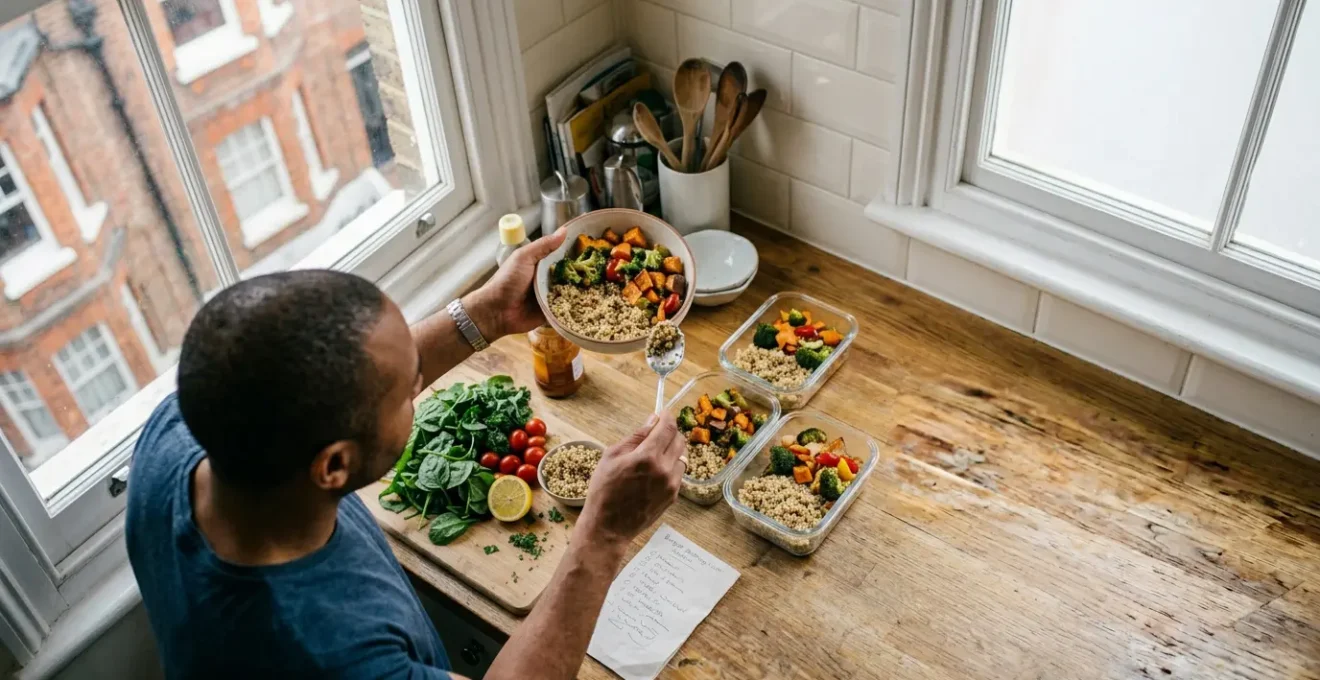
In summary:
- Stop planning ‘meals’; start building a ‘Culinary Operating System’ based on versatile components.
- Cook base proteins and grains once, then transform them daily with pre-made ‘flavour bombs’ (sauces and toppings).
- Use visual portioning (your hand is your guide) to eliminate tedious weighing and measuring.
- Leverage UK discount supermarkets (Aldi/Lidl) and ‘wonky veg’ schemes to hit the under-£40 target without sacrificing quality.
- Incorporate a 10-minute post-lunch walk into your commute routine to manage energy slumps.
The daily 12 PM scramble. That familiar question echoes across London offices: « What’s for lunch? » For busy professionals, the default answer is often a trip to Pret, a satisfying but costly habit that can easily drain over £200 a month. You know you should meal prep. You’ve heard the advice to « cook in bulk » and « plan your week, » but these platitudes often lead to a fridge full of bland, repetitive meals and a weekend lost to the kitchen.
The conventional approach to meal prep is broken. It focuses on recipes, not systems, and often ignores the critical factors of flavour fatigue and the science of keeping food fresh and appealing for a full five-day work week. It fails to account for the most precious resource of any London commuter: time.
But what if the key wasn’t more recipes, but a smarter framework? This guide introduces a ‘Culinary Operating System’ designed specifically for the time-poor, budget-conscious London professional. We’ll move beyond generic tips to deliver a strategic method for creating a week of varied, delicious, and healthy lunches for under £40, all in a single 90-minute session. This isn’t just about saving money; it’s about reclaiming your lunch hour, your health, and your weekend.
This article provides a complete roadmap, from choosing the right containers to understanding the economic trade-offs of your ingredients. You’ll learn how to build a flexible system that adapts to your life, not the other way around. Let’s explore the core components of this efficient approach.
Summary: Your System for Mastering London Meal Prep Under £40
- Glass vs Plastic Containers: Which Keeps Food Fresher for 5 Days?
- The « Base Ingredient » Method: How to Cook Once and Eat 3 Different Meals?
- How to Prep a Full Week of Lunches in Under 90 Minutes?
- Which Foods Turn Mushy in the Freezer and What Should You Freeze Instead?
- How to Portion Control Proteins and Carbs Without Weighing Every Meal?
- Dried Beans vs Canned: How Much Money Does Soaking Your Own Pulses Save?
- Walking After Meals: How 10 Minutes of Movement Lowers Blood Sugar Spikes?
- How to Eat a Whole Foods Diet on a Strict Budget in the UK?
Glass vs Plastic Containers: Which Keeps Food Fresher for 5 Days?
The first decision in any meal prep system is your hardware: the containers. While cheaper plastic tubs are tempting, they are a false economy for a five-day prep strategy. Plastic is porous, meaning it absorbs odours and stains (the ghost of last week’s bolognese is a familiar sight). More importantly, it allows for greater oxygen transfer, which accelerates food degradation and leads to that dreaded « fridge taste » by Thursday.
Glass, being non-porous and airtight, offers superior performance. It acts as a neutral vessel, preserving the intended flavour and texture of your food. For a professional who has grown accustomed to decent-tasting lunches, this is a non-negotiable advantage. Investing in a set of quality borosilicate glass containers with locking lids is the cornerstone of ensuring your Friday lunch is as appealing as Monday’s.
Case Study: The 6-Week Chili Test
To quantify this, consider a simple experiment. A meal-prep enthusiast in Portland tested identical portions of chili over six weeks. The results were definitive: the glass-stored chili maintained a richer flavour and thicker consistency up to day five. In contrast, the plastic versions began developing an « off-taste » and a slimier texture by day four, a process attributed to faster fat oxidation and microbial activity within the porous plastic.
The upfront cost of glass is higher, but their durability and performance make them a one-time investment in the quality of your weekly meals. They are also more environmentally friendly and safer for reheating, as there’s no risk of chemicals leaching into your food.
Ultimately, choosing glass is the first step in treating your home-prepped lunch with the same respect as a meal you’d pay for, ensuring your efforts are rewarded with satisfying food all week long.
The « Base Ingredient » Method: How to Cook Once and Eat 3 Different Meals?
The biggest pitfall of traditional meal prep is flavour fatigue. Eating the same chicken and broccoli for five days straight is the fastest way to abandon the practice and head back to Pret. The solution is not to cook five different meals, but to adopt the « Base Ingredient » or « Component Cooking » method. This is the core of our Culinary Operating System: cook your building blocks, then assemble them differently each day.
The strategy is simple: on Sunday, you’ll batch-cook a neutral protein (e.g., plain grilled chicken breast, lentils) and a versatile carbohydrate (e.g., quinoa, brown rice). These are your ‘bases’. They are stored plain. The magic happens with « Flavour Bombs »: small, potent batches of sauces, dressings, and toppings that can completely transform your base ingredients in seconds.
As the image demonstrates, the same foundation can be taken in entirely different directions. A scoop of quinoa and chicken can become a zesty South American bowl with chimichurri one day, a rich Asian-inspired meal with satay sauce the next, and a fresh Mediterranean lunch with lemon-tahini dressing on Wednesday. This approach provides the efficiency of batch cooking with the variety of à la carte dining.
Your 3-Step Flavour Bomb Strategy
- Batch-cook your base proteins and grains on Sunday (e.g., 500g chicken breast, 400g quinoa) and store them in plain containers.
- Prepare three distinct ‘flavour bomb’ sauces in small portions (e.g., 100ml each): a vibrant Satay, a zesty Chimichurri, and a creamy Lemon-Tahini.
- Assemble meals daily by combining base components with one sauce, transforming the same ingredients into globally-inspired dishes throughout the week.
By separating the cooking of bases from the flavouring, you create a flexible, efficient system that keeps your taste buds engaged and your commitment to meal prep strong.
How to Prep a Full Week of Lunches in Under 90 Minutes?
The promise of saving time is a primary motivator for meal prepping. Indeed, research shows that dedicated meal preppers can save between 6 and 8 hours per week that would otherwise be spent on daily cooking and cleaning. For a London professional, this reclaimed time is invaluable. The key to unlocking these savings is a ruthlessly efficient 90-minute workflow, inspired by professional kitchens’ ‘mise en place’.
Forget multitasking in a chaotic way. The 90-minute session is about sequential, focused blocks of activity. Don’t start cooking until all your vegetables are chopped. Don’t start assembling until all your components are cooled. This methodical approach minimizes cognitive load and maximizes output.
Here’s a potential breakdown of your 90 minutes:
- Minutes 0-20: Mise en Place. Unpack your groceries. Wash and chop all vegetables for the week. Preheat the oven. This is the most crucial step for a smooth process.
- Minutes 20-50: Active Cooking. This is the ‘peak activity’ phase. Get your base grains (rice, quinoa) cooking on the hob. Simultaneously, get your base protein (chicken, tofu) and roasting vegetables in the oven. While they cook, prepare your ‘flavour bomb’ sauces.
- Minutes 50-70: Cooling & Cleaning. As components finish cooking, spread them on baking sheets to cool quickly and evenly. This is critical to prevent a ‘mushy’ texture. While they cool, do a full clean-down of your kitchen. You should never leave the cleanup for later.
- Minutes 70-90: Portioning & Storage. Once bases are cool, portion them into your glass containers. Store ‘flavour bombs’ in separate small pots. Your week’s lunches are now ready for ‘grab and go’ assembly each morning.
By treating your Sunday prep like a professional appointment with a clear agenda, you transform a potential chore into a high-leverage activity that pays dividends all week.
Which Foods Turn Mushy in the Freezer and What Should You Freeze Instead?
While our system focuses on a five-day fresh prep, leveraging the freezer is a powerful strategy for long-term efficiency and cost-saving. However, freezing is not a one-size-fits-all solution. The science is simple: foods with high water content form large ice crystals when frozen. Upon thawing, these crystals melt, rupturing the food’s cellular structure and resulting in a disappointingly mushy, watery texture. This is why a frozen cucumber or lettuce salad is a culinary disaster.
Understanding what freezes well and what doesn’t is essential for avoiding waste and disappointment. The goal is to freeze components that are structurally robust or where a slight texture change won’t matter, especially in cooked dishes like soups, stews, and curries. A definitive guide from food safety experts can help distinguish between what to freeze and what to keep fresh.
| Food Category | Avoid Freezing (Texture Issues) | Freeze Successfully | Prep Tip |
|---|---|---|---|
| Vegetables | Lettuce, cucumber, raw celery, radishes | Broccoli, green beans, carrots, peas (blanched) | Blanch for 2-3 minutes before freezing to preserve texture and color |
| Dairy & Sauces | Mayonnaise, cream-based sauces, soft cheeses | Hard cheeses (grated), milk (for cooking use) | Freeze cheese pre-grated; accept slight texture change for cooked dishes |
| Proteins | Previously frozen/thawed meat | Raw chicken, beef, marinated proteins, cooked beans | Portion into individual servings; marinate before freezing for flavor |
| Grains & Legumes | Cooked pasta (alone, becomes mushy) | Cooked rice, quinoa, lentils, bean chili | Cool completely, freeze in portions; reheat with added liquid |
| Herbs & Aromatics | Fresh whole herbs (wilt badly) | Chopped herbs in olive oil (ice cube trays) | Freeze in oil to preserve flavor; drop one cube into dishes |
The ‘Prep Tip’ column is particularly valuable. For instance, blanching vegetables before freezing deactivates enzymes that cause loss of flavour and colour. Similarly, freezing chopped herbs in olive oil in ice cube trays creates perfect, single-serving ‘flavour bombs’ ready to be dropped into a pan.
By mastering the freezer, you can batch cook on an even larger scale, turning one Sunday’s work into components for weeks of varied meals, further enhancing your system’s efficiency.
How to Portion Control Proteins and Carbs Without Weighing Every Meal?
Portion control is key to both managing your budget and achieving your health goals. However, for a busy professional, the idea of pulling out a food scale for every meal is a non-starter. It’s tedious, time-consuming, and precisely the kind of friction that leads to abandoning meal prep. The solution is to use a set of reliable, visual heuristics that are accurate enough to be effective but simple enough to be sustainable.
Your own hand is the most convenient and personalized portioning tool you have. It’s always with you, and its size is proportional to your body. This method removes the need for any equipment and allows for rapid, confident portioning during your 90-minute prep session.
The system is straightforward: a serving of dense protein like chicken or fish should be about the size and thickness of your palm. A serving of carbohydrates like rice or quinoa should fit in your cupped hand. A serving of vegetables should be roughly the size of your clenched fist. This simple 3-part guide ensures a balanced macronutrient profile in every meal without any need for scales.
Your 5-Point Visual Portioning Audit
- Protein check: Does your protein serving (chicken, fish, tofu) match the size and thickness of your palm? This ensures around 20-25g of protein.
- Carbohydrate check: Is your portion of cooked rice or quinoa equivalent to what you can hold in one cupped hand?
- Vegetable check: Does your serving of vegetables (raw or cooked) roughly equal the size of your clenched fist?
- Batch cooking measure: Are you using a standard UK builder’s mug (approx. 300ml) as a consistent unit for cooking bulk grains? One dry mug yields 2-3 meal portions.
- Container consistency: Have you chosen a standard container size (e.g., 750ml) that perfectly holds one meal? If so, your goal is simply to ‘fill the box’.
By internalizing these hand-based measurements, you embed portion control directly into your workflow, making it an automatic and effortless part of your Culinary Operating System.
Dried Beans vs Canned: How Much Money Does Soaking Your Own Pulses Save?
In the quest to eat well under £40, every ingredient choice matters. Pulses like chickpeas and lentils are budget-superfoods, but the choice between dried and canned versions presents a classic « Time-Value Arbitrage » problem for the busy professional. Canned beans offer ultimate convenience, while dried beans promise significant cost savings. The question is: is the time spent soaking and cooking worth the money saved?
Let’s look at the numbers. The cost difference is stark. Cooking from dried can reduce the cost per serving by over 65%, which can add up significantly over a year. For anyone on a strict budget, this is a compelling reason to make the switch.
The following table, based on prices from common UK supermarkets, breaks down the exact financial benefit of cooking your own chickpeas.
| Product Type | Retailer Example | Package Size | Price (£) | Cooked Yield | Cost per 100g Cooked | Annual Savings (1 can/week) |
|---|---|---|---|---|---|---|
| Dried Chickpeas | Lidl | 500g bag | 0.89 | ~1.25kg cooked | 0.07 | – |
| Canned Chickpeas | Tesco Express | 400g can (240g drained) | 0.55 | 240g ready | 0.23 | – |
| Weekly Cost Comparison (for 240g cooked chickpeas) | ||||||
| Dried (home-cooked) | £0.17 per week | Save £19.76/year | ||||
| Canned (ready-to-use) | £0.55 per week | Reference | ||||
Case Study: The London Professional’s Time vs. Money Trade-off
The real analysis comes from balancing cost with time. As one analysis for London professionals highlights, the decision is nuanced. While traditional soaking and boiling can take hours, modern methods dramatically cut this down. Using a pressure cooker reduces active cooking to just 20-25 minutes. Even the ‘quick soak’ method (boiling for 2 minutes, then soaking for 1 hour) fits within a Sunday prep session. For a professional earning £15/hour, the 38p saved per ‘can’ easily outweighs the 20 minutes of active cooking time, making home-cooking the economically rational choice when efficient methods are used.
Therefore, integrating a pressure cooker into your kitchen arsenal makes cooking dried beans not just cheaper, but also time-efficient enough for any busy Londoner’s schedule.
Walking After Meals: How 10 Minutes of Movement Lowers Blood Sugar Spikes?
Your meal prep doesn’t end when you pack your lunch. How you spend the time *after* you eat is a crucial, often-overlooked part of the system. The notorious post-lunch slump, that feeling of lethargy that hits around 2 PM, is largely caused by a spike and subsequent crash in blood sugar after a carbohydrate-rich meal. A short, brisk walk is a scientifically proven antidote.
When you walk, your muscles act like sponges, soaking up glucose from your bloodstream for energy. This blunts the sharp spike in blood sugar, leading to more stable energy levels throughout the afternoon. A mere 10 minutes of light activity is all it takes to trigger this effect. For a London commuter, this can be seamlessly integrated into the workday, transforming a simple break into a powerful metabolic tool.
The key is to make it a non-negotiable part of your routine. Instead of scrolling through your phone at your desk after eating, get up and move. To make this actionable, here are some hyper-local, 10-minute walking circuits you can do in major London office districts.
Your 10-Minute ‘Metabolic Commute’ in London
- Canary Wharf Circuit: Exit your office towards Cabot Square, loop around the water features, and return via the green space of Jubilee Park. Total: 10-12 minutes.
- The City Loop: From the Bank area, walk towards the hidden Finsbury Circus Garden, do one lap of the garden path, and return via quieter side streets. Total: 10 minutes.
- Holborn Heritage Walk: Head towards Lincoln’s Inn Fields, walk the perimeter path past the historic architecture, and return. Total: 10-12 minutes.
- Rainy Day Stairwell Challenge: Use your office stairwell. Climb 2-3 flights at a moderate pace, walk down slowly, and repeat for 10 minutes to get the benefits without leaving the building.
- The Productive Stroll: Combine your walk with an errand, like posting a letter or grabbing milk from a Tesco Metro for home, to maximize time efficiency.
By adding this ‘metabolic commute’ to your lunch hour, you complete your wellness system, ensuring the healthy food you’ve prepped works optimally for your body and mind.
Key takeaways
- The most effective meal prep is a ‘Culinary Operating System’, not a collection of rigid recipes. Focus on versatile components.
- Strategic shopping is non-negotiable. Prioritise UK discount supermarkets (Aldi/Lidl), ‘wonky veg’ schemes, and bulk-buying staples.
- Food science matters. Use glass containers to preserve flavour and master the rules of freezing to avoid waste and texture issues.
How to Eat a Whole Foods Diet on a Strict Budget in the UK?
The ultimate goal is to fuse health with frugality: eating a diet rich in whole foods while adhering to a strict £40 weekly budget. It seems like a paradox, especially in a city as expensive as London. However, with strategic planning, it is not only possible but straightforward. For context, in FYE 2024, UK households spent an average of 11.3% of their expenditure on food, a figure that highlights the significant impact of smart food budgeting.
The foundation of this strategy is choosing where you shop. Mainstream supermarkets in central London are built for convenience, not value. By making a dedicated weekly trip to a discount chain like Aldi or Lidl, you can cut your core grocery bill by 20-30% instantly. This is the single biggest lever you can pull.
Case Study: The £40 Weekly Aldi Shopping List Challenge
To prove the concept, a budget-conscious Londoner built a complete shopping list from Aldi for under £40, providing ingredients for 5 full lunches and breakfast components. The list, detailed in a UK cost of food analysis, included: 500g chicken breast (£2.89), 1kg basmati rice (£1.99), 500g dried chickpeas (£0.89), 1kg frozen mixed veg (£0.99), 6 eggs (£1.39), 500g oats (£0.75), and fresh/seasonal items, totaling just £38.46. This provides concrete evidence that a whole-food meal prep budget under £40 is achievable.
Beyond the choice of supermarket, several other tactics are crucial for staying on budget while eating well. The following table outlines a multi-pronged strategy for UK shoppers.
| Strategy | How It Works | Example Retailers/Apps | Typical Savings | Best For |
|---|---|---|---|---|
| Wonky Veg Schemes | Purchase ‘imperfect’ vegetables at fixed low prices | Lidl ‘Too Good to Waste’, Morrisons ‘Wonky’ boxes | £1.50 for 5kg mixed veg | Weekly meal prep base vegetables |
| Discount Supermarkets | Shop at budget-focused chains for core ingredients | Aldi, Lidl | 20-30% lower than mainstream supermarkets | Staples: grains, pulses, frozen veg, proteins |
| Food Waste Apps | Purchase end-of-day surplus food from restaurants/cafes | Too Good To Go, Olio | £3-4 for £10-12 worth of food | Supplementing meal prep with variety, not primary source |
| Seasonal Produce | Buy UK-grown fruits/vegetables in season | All supermarkets, local markets | 30-50% cheaper than imported/out-of-season | Root veg in winter, courgettes/tomatoes in summer |
| Bulk Buying Staples | Purchase large quantities of long-life items | Costco, Asian supermarkets, online wholesalers | 15-25% per unit cost reduction | Rice, oats, dried beans, tinned tomatoes, spices |
Stop letting expensive, unsatisfying lunches happen to you. Take control this weekend by implementing this culinary operating system. Start with one component, like the Aldi shopping challenge or the 90-minute prep session, and build from there to reclaim your time, health, and finances.