
In summary:
- Lasting posture correction is a system, not a single fix. It involves re-engineering your environment and movement patterns.
- Focus on your 24-hour posture: optimize your workstation for the day and your pillow for the night.
- Counteract sitting by strengthening your upper back muscles (e.g., face pulls) and decompressing your spine (e.g., dead hangs).
- Address the foundation of your posture by correcting pelvic tilt and mastering fundamental prehab movements.
- Integrate these changes into a functional training approach that prepares your body for the demands of daily life.
If you’re an office worker, you know the feeling. That dull ache in your lower back by mid-afternoon, the persistent tension in your neck, and the subtle, creeping realization that you’re starting to resemble a human question mark. You’ve probably been told to « sit up straight » or « stretch more. » You might have even tried a few generic yoga poses you saw online. But the relief is temporary, and the slouch inevitably returns because these tips miss the fundamental point.
The common advice treats posture as a matter of willpower, a constant mental reminder to fight against gravity. This approach is doomed to fail. You can’t consciously manage your alignment every second of the day. But what if the goal wasn’t to *remember* good posture, but to create a system where it becomes your body’s effortless, default state? What if you could re-engineer your daily habits and environment to work *for* your spine, not against it?
This is the core of a corrective exercise approach. It’s not about quick fixes; it’s about understanding the underlying mechanics of your misalignment and implementing a holistic system. This involves a principle I call Environmental Ergonomics—shaping your workspace and sleep setup to support a neutral spine—and Neuromuscular Re-education, which involves specific exercises to retrain your muscles to hold you in that ideal alignment automatically. This guide will walk you through the key components of this system, providing a blueprint to not just relieve pain, but to build a truly resilient, aligned posture for life.
This article breaks down the essential components for building a robust postural system. The following sections provide a clear roadmap, guiding you through each critical aspect of spinal health, from your desk setup to foundational movements.
Summary: A System for Better Posture and Reduced Back Pain
- Monitor Height: Is Your Screen Position Causing Your Neck Pain?
- Face Pulls: The One Exercise You Need to Undo Slouching Shoulders
- Pillow Height: How to Keep Your Spine Neutral While Sleeping on Your Side?
- Dead Hanging: Can Hanging from a Bar Daily Relieve Lower Back Compression?
- Anterior Pelvic Tilt: Why Does Your Lower Back Arch Excessively Standing Up?
- Prehab Routine: The 5 Movements You Must Do Before You Turn 40
- Built-in Shelves: How to Hack IKEA Billy Bookcases for a Custom Look?
- How to Start Functional Training to Improve Mobility for Daily Life?
Monitor Height: Is Your Screen Position Causing Your Neck Pain?
The most common postural issue for any desk-bound professional is « tech neck, » or forward head posture. For every inch your head drifts forward, it effectively adds 10 pounds of pressure on your cervical spine. This isn’t a sign of laziness; it’s a direct response to your environment. Your body is simply trying to get your eyes closer to a screen that is poorly positioned. This constant forward flexion leads to overstretched and weakened upper back muscles and chronically tight chest and neck muscles, creating a painful and self-perpetuating cycle.
Adjusting your monitor is the single most impactful change you can make in your workday. It’s the cornerstone of Environmental Ergonomics. The goal is to position the screen so that a neutral spinal alignment becomes the path of least resistance. A single-subject intervention study confirmed that correctly adjusting both the chair and the visual display unit (VDU) is highly effective. The research demonstrated that VDU height directly affects neck alignment, with prolonged neck flexion being a primary cause of musculoskeletal disorders in computer users.
To correct this, you don’t need a fancy new desk, just a conscious setup. Follow these evidence-based guidelines:
- Position the monitor about 20-40 inches (an arm’s length) away from your eyes. This prevents you from leaning in to read.
- Adjust the height so the top edge of the screen is at or slightly below your eye level. This encourages you to keep your head stacked directly over your shoulders.
- If you wear bifocals, you may need to lower the monitor an additional 1-2 inches to find a comfortable viewing angle without tilting your head back.
- Ensure your keyboard and mouse are close enough that your elbows can remain bent at roughly 90 degrees, minimizing reach and shoulder strain.
Face Pulls: The One Exercise You Need to Undo Slouching Shoulders
Slouching shoulders are the physical manifestation of a muscular tug-of-war that you are losing. Hours spent hunched over a keyboard cause your pectoral (chest) muscles and anterior deltoids (front of the shoulders) to become short and tight. In response, the muscles of your upper back—the rhomboids, middle and lower trapezius, and posterior deltoids—become overstretched and weak. Simply telling yourself to « pull your shoulders back » won’t fix this deep-seated imbalance. You need to actively strengthen the weak muscles, teaching them to do their job again.
This is where Neuromuscular Re-education comes in, and the face pull is its superstar. This exercise specifically targets those neglected upper back muscles responsible for scapular retraction (pulling your shoulder blades together) and external rotation of the shoulder. It’s the direct antidote to the « internal rotation » posture of slouching. By strengthening these muscles, you change your body’s default setting, so your shoulders naturally sit back and down without conscious effort. It’s not just about building muscle; it’s about retraining a movement pattern.
Proper form is everything. You’re not just pulling a rope towards you; you’re initiating a sequence to retract and rotate. Using a cable machine with a rope attachment set at chest height, grab the ropes with an overhand grip. Pull the ropes towards your face while simultaneously pulling them apart. As you pull, focus on driving your shoulder blades together and rotating your hands up so your knuckles are pointing towards the ceiling at the end of the movement. Your end position should look like you’re flexing your biceps. As corrective exercise expert Jeff Cavaliere of ATHLEAN-X notes:
The face pull is so important and gives attention to so many important but underused muscles that you can perform it every single day.
– ATHLEAN-X, Face Pull Step by Step Guide
Pillow Height: How to Keep Your Spine Neutral While Sleeping on Your Side?
Your commitment to spinal alignment can’t end when you shut your laptop. You spend roughly a third of your life sleeping, and if your setup is wrong, you’re either undoing your daytime progress or actively worsening your posture for eight hours straight. For side sleepers—the majority of the population—the most common mistake is using a pillow that is too high or too low. A pillow that’s too thin will cause your head to drop, creating a lateral crunch in your cervical spine. A pillow that’s too thick will push your head upwards, creating the same problem in the opposite direction.
The goal is simple: your pillow should fill the exact space between your ear and the edge of your shoulder, keeping your entire spine in a perfectly straight, neutral line from your head to your pelvis. This is a critical extension of Environmental Ergonomics into the bedroom. You are creating a passive support system that maintains alignment while you rest and recover. This prevents muscular strain and allows your nervous system to fully relax, which is essential for healing the micro-damage from a long day.
Finding the right pillow height is a matter of personal anatomy. Here’s a protocol to follow:
- Measure your shoulder-to-ear distance: Stand facing a mirror and measure the distance from the outside edge of your shoulder to your ear. This is your target « loft » or pillow height.
- Support the neck curve: The pillow should fill the space under your neck, not just cradle your head. Many side-sleeper pillows have a contoured shape for this reason.
- Add a pillow between your knees: Placing a firm pillow between your knees prevents your top leg from falling forward. This is crucial as it stops your pelvis from rotating and twisting your lumbar spine.
- Consider your mattress firmness: If you have a very soft mattress, your body will sink more, and you may need a slightly lower pillow. On a very firm mattress, you’ll need a higher loft to fill the gap.
Dead Hanging: Can Hanging from a Bar Daily Relieve Lower Back Compression?
Throughout the day, gravity is relentless. It compresses the intervertebral discs in your spine, squeezing out fluid and reducing the space between vertebrae. For office workers, prolonged sitting exacerbates this compression, particularly in the lumbar (lower) and thoracic (mid) spine. While stretching can provide temporary relief, you need a more powerful tool for true spinal decompression. The dead hang is that tool.
By simply hanging from a pull-up bar, you allow your body weight to gently traction your spine, creating space between the vertebrae. This rehydrates the discs, alleviates nerve pressure, and releases tension in the deep muscles surrounding the spine, like the quadratus lumborum, a common culprit in lower back pain. It’s a simple, primal movement that directly counteracts the compressive forces of a sedentary day. However, there are two ways to hang, each with a distinct purpose.

The first is the passive hang, where you relax completely and let gravity do all the work. This is excellent for pure spinal decompression. The second, as shown above, is the active hang. In this variation, you engage the muscles around your shoulder blades by slightly pulling them down and back, as if initiating a pull-up. This not only decompresses the spine but also builds critical shoulder stability and grip strength, which are foundational for overall upper body health and injury prevention. A good practice is to accumulate 1-2 minutes of hanging per day, alternating between passive hangs for decompression and short active hangs for stability work.
Anterior Pelvic Tilt: Why Does Your Lower Back Arch Excessively Standing Up?
If your spine is a tower, your pelvis is its foundation. Any tilt or instability at the base will inevitably create compensations and strain all the way up to your head. One of the most common foundational issues for people who sit a lot is Anterior Pelvic Tilt (APT). This is a condition where the pelvis tilts forward, forcing the lumbar spine into an excessive arch (hyperlordosis). This leads to chronic tightness in the lower back and hip flexors, while the opposing muscles—the glutes and abdominals—become weak and underactive.
Think of your pelvis as a bucket of water. With a neutral pelvis, the water is level. With APT, the bucket is tilted forward, and the water is spilling out the front. This misalignment is a primary driver of lower back pain, but its consequences travel up the kinetic chain. This is the joint-by-joint approach in action: a problem at the hip causes a problem in the lower back, which can lead to compensations in the mid-back and, ultimately, the neck. It’s no surprise that a study of office workers found that 45.5% reported neck pain in the past year; these issues are often interconnected.

Correcting APT involves a two-pronged attack: stretching the tight muscles and strengthening the weak ones. The primary muscles to stretch are the hip flexors (through lunging stretches) and the lumbar erectors (through child’s pose or cat-cow). The primary muscles to strengthen are the glutes (with bridges and hip thrusts) and the deep core abdominals (with planks and dead bugs). Learning to find and maintain a neutral pelvic position during daily activities is the key to rebuilding your body’s foundation.
Prehab Routine: The 5 Movements You Must Do Before You Turn 40
Corrective exercise isn’t just about fixing existing pain; it’s about building a resilient body that’s prepared for the demands of life. This is the essence of « prehab »—proactively addressing potential weaknesses before they become injuries. For anyone spending significant time at a desk, establishing a routine of foundational movements is the best insurance policy against future back, neck, and shoulder issues. These aren’t intense workouts; they are simple, focused drills designed to restore and maintain proper function.
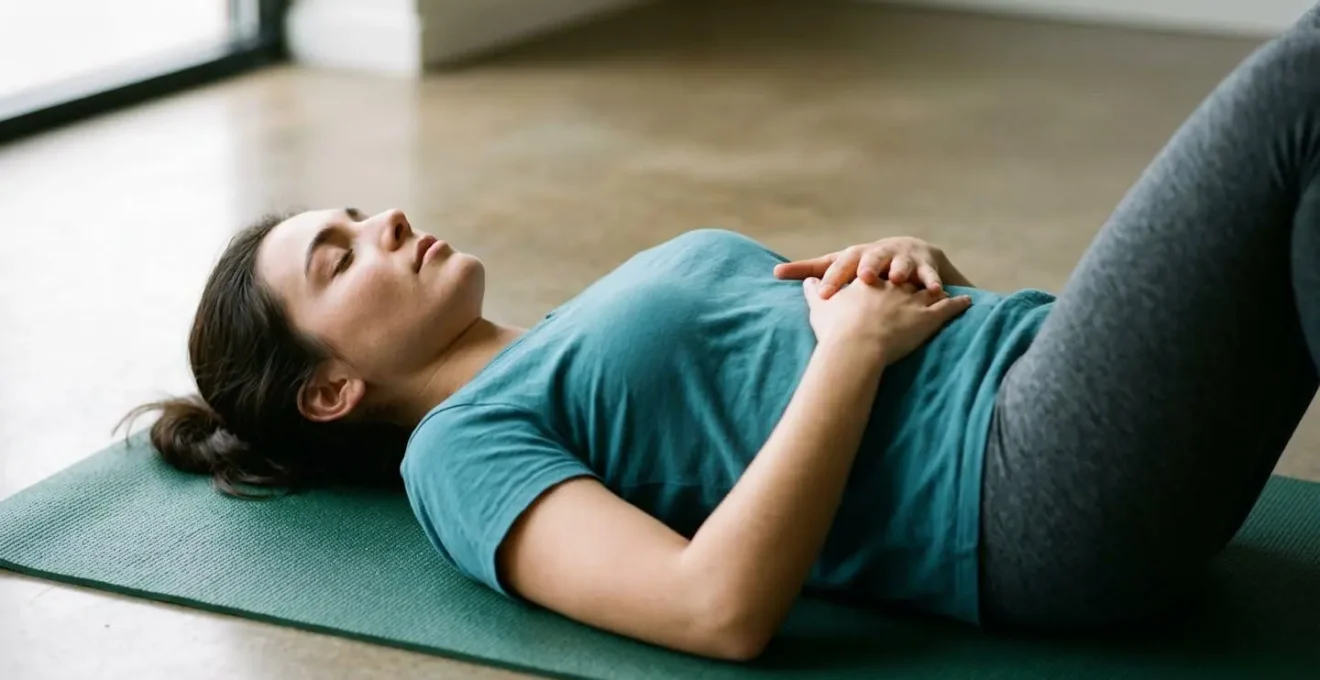
The most fundamental movement of all is breathing. Most people in a state of chronic stress or poor posture become « chest breathers, » using their neck and shoulder muscles. Diaphragmatic breathing, or « 360° breathing, » retrains you to use your diaphragm, the primary muscle of respiration. This technique creates intra-abdominal pressure, which acts as a natural corset to stabilize your spine from the inside out. It’s the starting point for all core stability.
Building on this foundation, a comprehensive prehab routine should address key areas of mobility and stability that are compromised by sitting. The goal is to ensure each joint can move as intended, so other parts of your body don’t have to compensate. This prevents the cascade of dysfunction that leads to chronic pain. The following five movements form a powerful routine for maintaining spinal health and postural integrity.
Your Essential Prehab Checklist: 5 Movements for Spinal Integrity
- 360° Diaphragmatic Breathing: Lie on your back with knees bent. Place one hand on your chest and one on your belly. Practice breathing so that your belly and ribcage expand in all directions (front, sides, and back) while your chest remains relatively still.
- Perfect Hip Hinge: Stand tall and place a dowel or broomstick along your spine, maintaining contact with your head, mid-back, and tailbone. Hinge at your hips by pushing your butt back, keeping the dowel in contact at all three points. This teaches you to bend with your hips, not your lower back.
- Thoracic Extension over Foam Roller: Lie with a foam roller positioned horizontally under your mid-back. Support your head with your hands and gently extend your spine over the roller. This restores the extension mobility that is lost from slouching.
- Quadruped T-Spine Rotations: Start on your hands and knees. Place one hand behind your head. Rotate your upper body, bringing your elbow down towards your opposite wrist, then up towards the ceiling. This unlocks thoracic rotation, protecting your neck and lower back.
- Short Foot Exercise: While seated or standing, try to shorten your foot by pulling the ball of your foot towards your heel without curling your toes. You should feel the arch of your foot engage. This builds the foundational stability of your entire postural chain.
Built-in Shelves: How to Hack IKEA Billy Bookcases for a Custom Look?
This title might seem out of place, but the analogy is surprisingly perfect. A well-built, stable shelving unit relies on the same principles as a well-aligned, stable body: a solid foundation, properly stacked components, and secure anchoring. Just as you wouldn’t expect a poorly assembled IKEA Billy bookcase to hold your prized possessions, you can’t expect a poorly aligned spine to support you through life without strain or pain. So, let’s « hack » this concept for your body.
Your body has three primary « shelves » that need to be stacked vertically to properly manage the force of gravity:
- The Pelvic Shelf: This is your foundation, your base unit. As we discussed, if this shelf is tilted (Anterior Pelvic Tilt), everything stacked on top of it will be unstable.
- The Thoracic Shelf: This is your ribcage. In a slouched posture, this shelf slides forward and rounds, causing the « slouching shoulders » and upper back curve (kyphosis).
- The Head Shelf: This top shelf is heavy—about 10-12 pounds. When the thoracic shelf below it slides forward, the head juts forward to compensate, creating tech neck.
Your « custom look » isn’t about aesthetics; it’s about creating a structure that is custom-fit to your anatomy and the demands of gravity. The goal is to align these three shelves vertically, one on top of the other. The « hack » is realizing that you can’t just fix the top shelf (your head) in isolation. You must start by leveling the foundation (your pelvis) and then properly positioning the mid-shelf (your ribcage) through exercises like face pulls and thoracic mobility drills. When the lower shelves are correctly aligned, the head naturally finds its place on top with minimal muscular effort.
Key Takeaways
- True postural correction is a system, not a checklist. It requires changing your environment and retraining your movement patterns.
- Spinal alignment is a 24-hour job. Your posture during your 8 hours of sleep is just as important as during your 8 hours at a desk.
- Focus on reversing common imbalances: strengthen your weak upper back and glutes, and release your tight chest and hip flexors.
How to Start Functional Training to Improve Mobility for Daily Life?
We’ve deconstructed the key elements of spinal alignment: your desk setup, your sleep position, specific corrective exercises, and foundational prehab movements. Now, how do we put it all together? The answer lies in functional training. This term is often misunderstood as complex gym workouts, but its true meaning is simpler and more profound: training your body to handle the demands of your daily life with efficiency and without pain.
For an office worker, functional training means being able to sit for extended periods without developing pain, lifting a box using your legs and not your back, and having the mobility to look over your shoulder without straining your neck. The system we’ve outlined *is* a form of functional training. By adjusting your monitor, you’re training a neutral neck position. By doing face pulls, you’re training your shoulders to remain externally rotated. By mastering the hip hinge, you’re training a safe bending pattern. This approach shifts the focus from isolated muscles to integrated movement patterns.
Starting is about integration, not addition. Begin by implementing one or two changes. Fix your monitor height this week. Next week, add a 5-minute prehab routine in the morning. The goal is to layer these habits until they form a new, resilient foundation. With studies indicating that up to 80% of people experience back pain at some point, adopting this proactive, systematic approach isn’t just about feeling better now—it’s about investing in a future of pain-free movement and improved quality of life.
The journey to better posture is a marathon, not a sprint. Start today by choosing one element from this guide and integrating it into your life. Your future self, free from chronic pain and standing tall, will thank you.