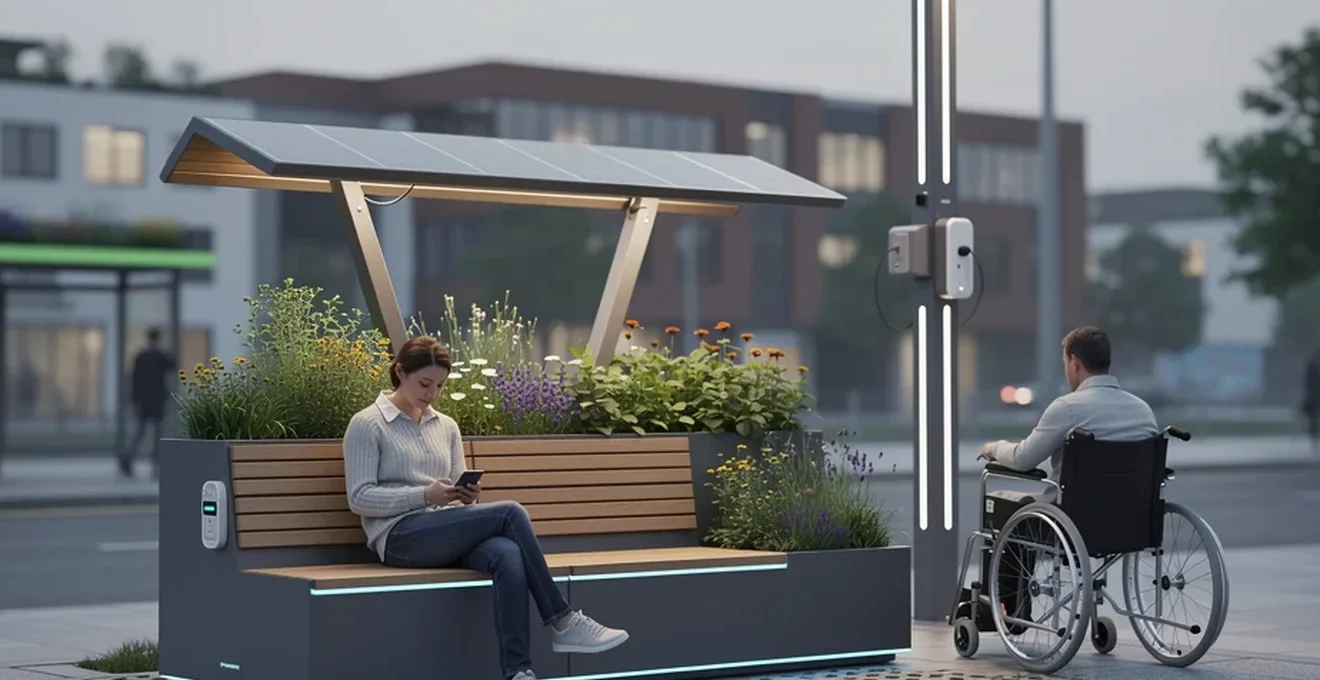
Urban furniture is no longer a matter of stone benches and identikit lamp posts. As cities densify and public space becomes a precious, contested resource, designers and municipal planners are reimagining benches, bus shelters, bins and lighting as active infrastructure. Today’s street furniture can monitor air quality, harvest solar energy, support biodiversity and adapt to the needs of ageing populations, all while remaining durable enough to survive decades of public use. This shift reflects a broader convergence of sustainability goals, smart city ambitions and a renewed focus on inclusivity. The following sections explore how sensor technology, sustainable materials, biophilic thinking, accessibility standards and modular design are converging to reshape the public realm, and what this means for the way people experience, and cities plan, the spaces between buildings.
Smart urban furniture: IoT-Enabled street fixtures transforming public spaces
The integration of smart technology into street furniture is one of the clearest trends reshaping public spaces. Features such as Wi-Fi-enabled benches, charging stations and interactive kiosks improve the user experience and encourage people to linger longer in public areas rather than simply passing through them. Beyond convenience, sufficiently smart street furniture can capture data from many points across a city, which can then be turned into useful information for pedestrians, from where the air quality is better to which part of a park is least congested.
Solar-powered smart benches: case studies from barcelona and singapore
Solar-powered lights and charging points built into benches are becoming a common feature of urban landscapes, allowing furniture to generate its own power for lighting or device charging rather than drawing on the grid. Cities that have invested heavily in smart city frameworks, including Barcelona, have used this kind of connected infrastructure to test how removable and technologically enabled furniture responds to fluctuating patterns of use and events. The appeal is straightforward: a bench that charges a phone or lights itself at dusk adds a layer of utility to what was once a purely passive object.
Sensor-integrated waste bins and Real-Time Fill-Level monitoring systems
Sensor-equipped furniture extends well beyond seating. IoT devices can monitor the condition or usage of street fixtures, feeding data back to maintenance teams so that issues are addressed before they become visible problems to the public. Applied to waste bins, this kind of monitoring allows municipal services to prioritise collection routes based on actual fill levels rather than fixed schedules, reducing unnecessary journeys while keeping public areas cleaner for longer.
Connected bus shelters with air quality sensors and digital displays
Bus shelters are increasingly being treated as data-gathering nodes rather than simple waiting points. Real-time transit displays and connected sensors can provide passengers with live information while also contributing to a wider network of environmental monitoring across the city. As computer vision technology becomes more accurate and accessible, visual data from the surrounding environment can be layered onto this information, adding a new dimension to what « smart » furniture is capable of reporting back to both residents and city planners.
Wi-fi-enabled street lighting: smart poles as Multi-Function infrastructure hubs
Street lighting is evolving from a single-purpose fixture into a multi-function hub. Poles fitted with Wi-Fi connectivity, sensors and even charging capability consolidate several services into one piece of infrastructure, reducing street clutter while increasing the amount of useful data and connectivity available to the public. This approach reflects a broader principle in smart city design: furniture is a natural access point for installing sensors, Wi-Fi, solar panels or digital signage, linking everyday city life to the wider smart city network in real time.
Sustainable materials in contemporary street furniture design
Sustainability sits at the heart of modern urban furniture design. Designers are increasingly turning to recycled and eco-friendly materials, such as reclaimed wood and recycled plastics, reducing environmental impact while aligning with wider carbon-reduction initiatives. This isn’t limited to material choice; it also extends to how furniture performs once installed, from collecting rainwater to generating solar power.
Recycled HDPE plastic applications in modular seating systems
Recycled plastics are now widely used in modular seating systems, offering a durable, low-maintenance alternative to virgin materials without compromising on design flexibility. This aligns with a circular economy approach in which furniture components can be replaced individually, reducing waste and extending the working life of an installation rather than requiring wholesale replacement.
Cross-laminated timber and FSC-Certified wood in public installations
Certified and sustainably sourced timber remains a favoured material for public installations, valued for its warmth and its ability to weather naturally while withstanding heavy use. Hardwood treated with UV-resistant oil finishes is one approach used to ensure longevity and durability in demanding outdoor conditions, helping furniture maintain both its structural integrity and its appearance over years of exposure to the elements.
Corten steel weathering techniques for Low-Maintenance urban fixtures
Powder-coated and pre-galvanised steel frames are commonly specified for their resistance to harsh environmental conditions, ensuring that furniture frames remain structurally sound with minimal maintenance. Weathering steel finishes, which develop a protective oxidised layer over time, offer a similar low-maintenance logic: the material’s ageing process becomes part of its durability strategy rather than a sign of decline.
Circular economy principles applied to Cradle-to-Cradle furniture manufacturing
A genuinely circular approach to furniture manufacturing goes beyond simply choosing eco-friendly materials; it considers the whole value chain, from sourcing to end-of-life. « Plug and play » furniture systems that facilitate part replacement, local repair and material reuse can reduce costs and multiply the lifespan of public investments. This means designing with interchangeable components in mind, so that a damaged section can be swapped out rather than the entire piece discarded, and thinking through reverse logistics, what happens when a piece eventually breaks, from the outset.
Biophilic design integration in street furniture architecture
The incorporation of nature into urban furniture is gaining traction through biophilic design principles. Furniture that includes planters or green elements doesn’t just beautify a space; it can contribute to environmental health by improving air quality and offering city dwellers a genuine, if modest, connection to nature that urban life often compromises.
Green roof bus stops and Pollinator-Friendly vegetative structures
Vegetated structures integrated into street furniture, including green roofs on shelters, extend biodiversity into spaces that would otherwise be purely functional. These installations can support pollinators and other indigenous species, effectively turning everyday infrastructure into a small-scale habitat and reflecting a wider ambition to better integrate flora and fauna within urban spaces.
Living wall installations combined with seating infrastructure
Living walls paired with seating bring greenery into areas where ground-level planting space is limited. Benches with integrated planters, for example, create green spaces while providing comfortable seating, offering people a place to unwind and benefit from the well-being boosts associated with time spent near nature, even within a dense urban footprint.
Permeable paving systems surrounding urban furniture clusters
Permeable paving around furniture clusters supports better water management in public spaces, allowing rainwater to filter through the ground rather than overwhelming drainage systems. When combined with planting and seating, this kind of surface treatment helps furniture clusters function as small, self-sustaining ecological units within the wider streetscape.
Universal design and ADA-Compliant accessibility standards in street furniture
Designing urban furniture with inclusivity in mind is essential for fostering genuine community engagement. This means creating seating and amenities that work for people of all ages and abilities, ensuring that public spaces remain welcoming rather than exclusionary by design.
Wheelchair-accessible bench heights and tactile paving integration
Accessible seating design includes practical details such as appropriate bench heights, backrests and armrests, all of which cater to a wider range of physical needs and promote social equity. Wheelchair-accessible seating and adjustable-height elements ensure that furniture serves the full spectrum of users, rather than assuming a single « average » body.
Braille signage and Audio-Assisted wayfinding kiosks
As digital interfaces become more common in public furniture, ensuring they remain accessible to people with visual impairments is essential. Wayfinding kiosks and signage that combine tactile and audio elements help ensure that the informational benefits of smart furniture, such as event details or transit updates, are genuinely available to everyone rather than only to those who can read a screen.
Adjustable-height public seating for multigenerational use
As populations live longer and have fewer children, urban furniture increasingly needs to cater to an ageing demographic, prioritising comfort, accessibility and opportunities for social engagement. Adjustable-height seating and varied configurations allow the same piece of furniture to comfortably serve a child, a wheelchair user and an older adult, supporting genuinely multigenerational use of public space.
Modular and adaptive furniture systems for flexible urban environments
Flexibility has become a defining feature of contemporary urban furniture. Modular systems allow for easy reconfiguration to accommodate different activities, from community events to quiet relaxation zones, ensuring that public spaces remain functional and inviting across a wide range of uses rather than being locked into a single purpose.
Parklet design frameworks inspired by san francisco’s Pavement-to-Parks programme
The parklet concept, converting small sections of street or parking space into miniature public seating areas, has influenced how designers think about reclaiming underused urban space for pedestrian benefit. These frameworks favour lightweight, removable structures that can be installed and taken down without permanently altering the street, giving cities the flexibility to test new public space uses at low risk.
Convertible street furniture for Pop-Up markets and temporary plazas
Removable and easily stored furniture has proven particularly useful for temporary events. In one example, fully removable sliding bleachers were designed for a public plaza to function as both a daytime meeting point and a nighttime performance area, with installation and removal taking under 20 minutes so the space could return to everyday use during working hours. Similar low-cost approaches, including storable calisthenics equipment for sports parks, show that this kind of flexibility can scale beyond flagship projects into everyday municipal provision.
Prefabricated modular units by manufacturers such as vestre and landscape forms
Prefabricated modular systems allow manufacturers to offer seating and structural elements that can be configured differently depending on a site’s layout and constraints. Curved benches that wrap around trees or other natural features, for instance, let a single modular product family adapt to plazas, walkways and intimate courtyards alike, with the same components telling a different story of the space depending on how they’re arranged.
Data-driven urban planning and the role of smart city frameworks
Taking a wider view of a city reveals patterns of pedestrian movement across an urban space. With sufficiently smart street furniture in place, planners can gather substantial amounts of data from numerous points and convert it into practical information, whether that’s identifying the least congested area of a park or the location with the best air quality.
Barcelona’s superblock model and furniture placement optimisation
Cities such as Barcelona have invested in removable and adaptable street equipment to respond directly to fluctuations in usage and specific events, rather than relying on fixed, one-size-fits-all installations. This approach to furniture placement reflects a broader planning philosophy in which street-level infrastructure is treated as something to be optimised continuously, based on how residents actually move through and occupy public space.
Singapore’s smart nation initiative and Sensor-Equipped public amenities
Sensor-equipped public amenities extend the concept of the smart city down to the level of individual benches and shelters, gathering usage data that can inform decisions about where new furniture is needed or where existing installations are underused. This granular data collection complements wider national digital infrastructure strategies, helping ensure that investment in public amenities is guided by evidence rather than assumption.
Predictive maintenance algorithms for street furniture asset management
Looking ahead, predictive maintenance is likely to become a more prominent feature of street furniture management. Furniture capable of recording usage levels or environmental exposure could send preventive maintenance alerts before a fault becomes visible or hazardous, reducing repair costs and downtime. The ambition is furniture that not only serves the public but actively reports on its own condition, allowing cities to shift from reactive repairs to planned, predictive upkeep across thousands of individual street assets.