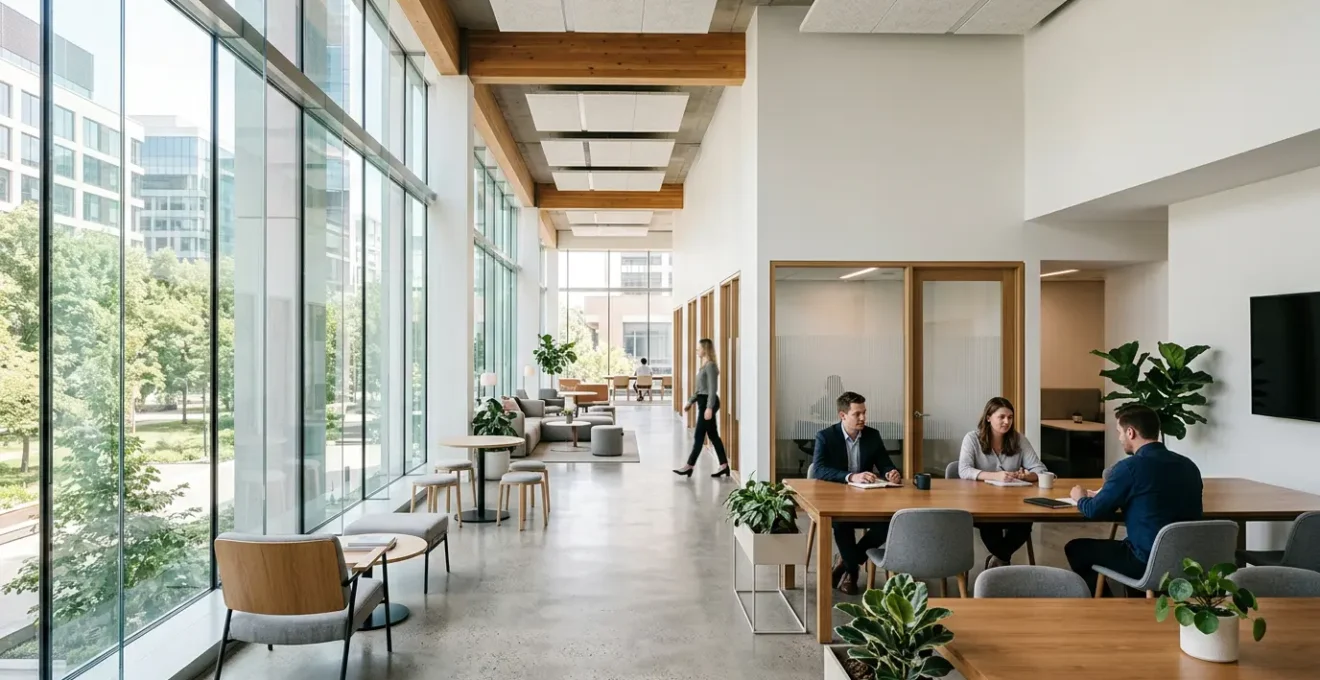
To succeed in the new era of hybrid work, coworking investors must shift from simply leasing square footage to engineering a high-retention « operational stack » of space, technology, and services.
- Profitability is driven by a strategic mix of private offices and a robust, integrated technology backbone, not just hot desks and free beer.
- Competing with giants like WeWork requires carving out a defensible niche and delivering a superior member experience that solves real hybrid work challenges.
Recommendation: Focus initial capital on a core tech platform and a design that prioritizes a higher ratio of private offices to create a scalable, recurring revenue engine from day one.
The rise of hybrid work has irrevocably changed the commercial real estate landscape. For astute investors and operators, this isn’t a crisis; it’s the single greatest opportunity of the decade. The demand for flexible, high-quality workspaces in commuter towns and suburbs has exploded. Yet, launching a successful coworking space is no longer about offering good coffee and fast Wi-Fi. Many new investors fall into the trap of competing on price or replicating the generic, open-plan models of the past.
The common wisdom revolves around building « community » and offering « flexibility, » but these terms have become platitudes. True success lies in a more profound, systemic approach. The key isn’t just one element—not just the design, the pricing, or the events—but the masterful integration of all of them. What if the secret to capitalizing on this trend wasn’t about being the cheapest or the biggest, but about building a deeply integrated operational stack? This is a system where space design, technology, and service offerings work in concert to create a high-retention, high-margin business engine that is difficult for competitors to replicate.
This guide moves beyond the basics to provide a strategic framework for investors. We will dissect the critical components of this operational stack, from determining the most profitable space mix and implementing a secure tech backbone, to designing community events with real ROI and competing effectively against industry giants. It’s time to stop thinking like a landlord and start thinking like a tech-enabled hospitality provider.
To navigate this complex landscape, this article provides a detailed roadmap. Explore the key strategic pillars below to build a resilient and profitable coworking investment.
Summary: Investing in Coworking for the Hybrid Future
- Hot Desks vs Private Offices: What Is the Most Profitable Space Mix?
- Community Events: Why Free Beer Isn’t Enough to Retain Members?
- Keyless Entry Systems: How to Manage 24/7 Access Securely?
- Day Pass vs Monthly: How to Price Flexibility Without Losing Recurring Revenue?
- WeWork vs Local Independents: How Can Small Spaces Compete on Niche Appeal?
- Anchor Days: How to Coordinate Office Presence for Maximum Collaboration?
- Philips Hue vs Wi-Fi Bulbs: Which Is More Reliable for Voice Control?
- How to Manage a Hybrid Schedule Without Burning Out or Losing Visibility?
Hot Desks vs Private Offices: What Is the Most Profitable Space Mix?
For new investors, the allure of a bustling, open-plan hot desk area is powerful. It seems to embody the very idea of coworking: dynamic, collaborative, and flexible. However, from a revenue perspective, this image is misleading. The financial foundation of a modern, profitable coworking space is not the transient hot-desker; it’s the stable, high-value private office tenant. While hot desks provide vibrancy and a low-barrier entry point for new members, they are a low-margin, high-churn component of the business.
The strategic imperative is to maximize revenue density, and private offices are the undisputed champions. In fact, industry data reveals that private offices can generate up to 60% of total revenue, despite occupying a smaller fraction of the total floor plan. They offer clients privacy, security, and a stable « home base, » for which they are willing to pay a significant premium and commit to longer terms. This creates a predictable, recurring revenue stream that is essential for financial stability and growth.
Therefore, the optimal space mix for a new build-out in a commuter town should heavily favor private offices of varying sizes (from 1-person pods to 4-6 person team rooms). A smart model might allocate 50-60% of leasable square footage to private offices, 20-25% to meeting rooms and event spaces (another high-margin revenue stream), and only 15-20% to open-plan hot desk and lounge areas. This configuration secures a strong financial base while still offering the flexibility and community atmosphere that attracts a diverse membership.
This office-first strategy ensures that your investment is built on a foundation of recurring revenue, allowing you to weather market fluctuations and fund the very community initiatives that make your space thrive.
Community Events: Why Free Beer Isn’t Enough to Retain Members?
Every coworking operator talks about « community, » but few understand how to build one that translates directly to the bottom line. The default approach—offering free beer, pizza, and social mixers—is a common and costly mistake. While these events can create a temporary buzz, they rarely foster the deep connections that lead to member retention. In the context of a professional workspace, members are not primarily seeking new friends; they are seeking to grow their businesses and careers. A successful community strategy must be aligned with this core professional motivation.
The financial impact of getting this right is staggering. Retention is the most powerful lever for profitability. A Bain & Company study demonstrates that a 5% increase in customer retention can lead to a 25% to 95% profit increase. The goal, therefore, is not just to host events, but to facilitate « intentional collisions »—structured opportunities for members to connect in ways that create tangible professional value. This means shifting the focus from purely social gatherings to events centered on business acceleration, skill-building, and knowledge sharing. Think peer-to-peer mastermind groups, workshops on digital marketing, or « lunch and learn » sessions with local industry experts.
Case Study: The Shift to Value-Driven Programming
Leading independent operators are proving that a focus on professional value is the key to high retention. Spaces that implement targeted business acceleration programs, personalized service touchpoints, and workshops are maintaining retention rates above 90%. By tracking metrics and focusing on member growth, they transform their community from a cost center (free beer) into a core part of their value proposition, creating a loyal base that larger, more generic competitors cannot poach.
These events create a stickier ecosystem where the value of membership extends far beyond a desk and a chair. Members who close a deal, find a co-founder, or learn a new skill at a space-hosted event are exponentially more likely to renew their membership. This is the true ROI of community.

As the image illustrates, genuine engagement happens when the environment is designed to foster professional growth and collaboration. It’s about creating a space where business happens, not just a place where people work. By investing in a community manager who is a business connector rather than just an event planner, you build a powerful engine for member retention and long-term profitability.
Ultimately, a successful community is not measured by the number of empty beer bottles, but by the number of business success stories it helps to create.
Keyless Entry Systems: How to Manage 24/7 Access Securely?
Offering 24/7 access is a powerful differentiator for a coworking space, especially in commuter towns where members keep non-traditional hours. It meets a core need for flexibility and significantly increases the perceived value of a membership. However, for an operator, it presents a major operational and security challenge: how to provide seamless, round-the-clock access without incurring the prohibitive cost of 24/7 staffing. The answer lies in a robust, modern keyless entry system, which forms a critical part of your facility’s tech backbone.
Traditional keys and fobs are an operational nightmare. They are easily lost, expensive to replace, and impossible to manage dynamically. A modern, cloud-based access control system solves these problems. It allows operators to grant, revoke, and schedule access for members remotely via a central dashboard. Members can use their smartphones as a digital key, providing a frictionless experience. This technology is the enabler of a secure, unstaffed, 24/7 operation, which is a significant competitive advantage.
The security research indicates that a primary challenge for flexible workspaces is managing a 24/7 operation with reduced staff. An integrated access system directly addresses this. By linking access control to your coworking management software, you can automate permissions based on membership level and real-time bookings. For example, a member who books a meeting room for 7 PM on a Saturday can be granted automatic, time-limited access to the main door and that specific room, with all permissions revoking automatically after the booking ends. This level of automation reduces administrative overhead, eliminates security gaps, and provides invaluable data on space utilization.
Action Plan: Selecting Your Access Control System
- Evaluate cloud vs. local access control systems based on smartphone unlock requirements and data sovereignty needs.
- Assess integration capabilities with coworking management platforms for automated desk bookings and meeting room reservations.
- Verify API availability and compatibility with existing software to avoid vendor lock-in.
- Plan scalability roadmap considering 2-5 year growth projections for multi-location deployments.
- Select systems supporting both mobile credentials (Bluetooth, NFC, Apple Wallet) and traditional keycards for hybrid member preferences.
Investing in the right keyless entry system is not a simple line-item expense; it’s a strategic investment in operational efficiency, security, and a superior member experience that underpins the entire flexible business model.
Day Pass vs Monthly: How to Price Flexibility Without Losing Recurring Revenue?
Pricing is one of the most complex levers an operator has to pull. The challenge is to balance the market’s demand for flexibility (day passes, on-demand bookings) with the business’s need for predictable, recurring revenue (monthly memberships). A poorly designed pricing strategy can lead to a space full of low-margin, high-turnover users, eroding profitability and community stability. The key is to use flexible pricing as a strategic funnel, not as the core business model.
Day passes and flexible access packs should be viewed as top-of-funnel marketing tools. They are an excellent way to introduce new people to your space, lower the barrier to entry, and capture revenue from occasional users or business travelers. However, they must be priced at a premium on a per-day basis compared to monthly memberships. This creates a clear value proposition for commitment. For example, if a day pass is $35, a 10-day pass pack is $300, and a monthly hot desk membership is $250, the user who plans to come more than seven times a month is financially incentivized to upgrade to a recurring membership.
The core of your revenue strategy must be anchored in monthly recurring revenue (MRR). According to 2026 industry benchmarks, the average monthly hot desk membership is around $215, with dedicated desks commanding closer to $325. These are the numbers that should form the financial bedrock of your operation. Furthermore, a successful strategy diversifies revenue beyond just desk rentals. As DeskMag data reveals, reliance on pure desk rental revenue dropped from 56% in 2016 to 38% in 2023. Profitable spaces now generate significant income from ancillary services like meeting room bookings, event space rentals, virtual office packages, and even enterprise solutions for hybrid teams.
Ultimately, your pricing structure should tell a story, guiding users from a first-time, low-commitment interaction towards a long-term, high-value relationship that benefits both the member and your bottom line.
WeWork vs Local Independents: How Can Small Spaces Compete on Niche Appeal?
For an independent operator entering the market, the shadow of giants like WeWork can be intimidating. These large chains benefit from massive brand recognition, economies of scale, and vast marketing budgets. Attempting to compete with them on price or size is a losing battle. However, their scale is also their greatest weakness. The path to success for a local, independent space is not to be a smaller, cheaper version of WeWork, but to be something fundamentally different: a highly specialized, community-focused, niche operator.
The global coworking market is surprisingly concentrated; market analysis demonstrates that the top 10 providers control 42% of the market share. This leaves a significant portion of the market open for smaller players who can offer a more tailored experience. The strategy is to go deep, not wide. Instead of trying to be everything to everyone, a niche operator identifies a specific, underserved segment of the local market and builds an entire experience around their unique needs. This could be a space for lawyers with soundproofed offices and a law library, a space for creative professionals with a photo studio and editing suites, or a space for working parents with on-site childcare.

This niche focus creates a powerful « moat » around the business. By offering specialized amenities, targeted programming, and a community of like-minded peers, the space becomes an indispensable resource for its target demographic. This fosters incredible loyalty and high retention rates that large, impersonal operators cannot match. The physical environment itself, as shown in the boutique design above, becomes a key differentiator—it reflects the values and aspirations of its specific community, offering an authenticity that cannot be mass-produced.
Case Study: Thriving Through Specialization
Independent spaces are achieving remarkable success by focusing on hyper-local and demographic niches. For example, women-focused spaces with enhanced safety features and wellness amenities, or tech-startup-focused hubs with direct access to mentors and venture capitalists, build tight-knit communities. These operators deliver personalized service and foster deep collaboration within a specialized group, creating a value proposition that is immune to competition from generalist providers.
In a world of corporate giants, being small, local, and highly specialized is not a disadvantage—it is your single greatest competitive advantage.
Anchor Days: How to Coordinate Office Presence for Maximum Collaboration?
The concept of « Anchor Days »—specific days of the week when teams are required to come into the office—is a direct response to the collaboration challenges of a dispersed workforce. For a coworking operator, this trend represents a significant B2B opportunity. Companies are actively seeking flexible, third-party spaces to host these anchor days, especially if their own office footprint has been reduced or is geographically inconvenient for a distributed team. Your space can become the go-to solution for corporate teams looking for a place to connect, collaborate, and build culture.
To capitalize on this, you must position your space not just as a collection of desks, but as a « collaboration hub » for hire. This means marketing directly to HR managers and team leads, offering packages that cater specifically to their needs. These « Anchor Day Packages » could include the exclusive use of a block of dedicated desks, guaranteed access to a large meeting room or workshop space, catering services, and facilitation tools like whiteboards and high-end AV equipment. You are selling a seamless, turnkey solution for a company’s collaboration needs.
The data strongly supports this strategic pivot. As corporate real estate strategies evolve, an Instant Group survey of over 200 office occupiers found that their ideal workspace portfolio includes 31% of time spent in coworking spaces, second only to the corporate headquarters. This shows a clear and growing demand from enterprises for flexible workspace partners. By actively courting this market with tailored solutions for their anchor day strategies, you can secure large, recurring B2B contracts that provide a stable revenue stream far beyond individual memberships.
By understanding the pain points of hybrid team management and offering a frictionless solution, your coworking space can become an indispensable part of the new corporate ecosystem.
Philips Hue vs Wi-Fi Bulbs: Which Is More Reliable for Voice Control?
At first glance, a question like « Philips Hue vs. Wi-Fi Bulbs » seems purely tactical, a minor detail in the grand scheme of a multi-million dollar investment. However, for an investor, it’s a microcosm of the single most important technology decision you’ll make: adopting an integrated platform versus assembling disparate point solutions. This choice forms the core of your tech backbone and has massive implications for scalability, member experience, and long-term ROI. A Wi-Fi bulb is a point solution; a Hue system, with its hub, is a step towards a platform. The real strategic choice is to go a level higher.
The Point Solution approach involves purchasing individual, often best-in-class, technologies for each need: one vendor for access control, another for meeting room booking, a third for billing, and a fourth for community engagement. While this may seem cheaper upfront, it quickly becomes an operational and financial quagmire. These systems don’t talk to each other, creating a fragmented experience for both members (who need multiple apps and logins) and staff (who must manage multiple dashboards). Integration costs are high, and you become dependent on a fragile chain of vendors, where a single point of failure can disrupt your entire operation.
The Integrated Platform approach, by contrast, provides a single, unified system to manage the entire coworking operation. One software platform handles everything from a member signing up and gaining door access with their phone, to booking a room, paying their invoice, and RSVPing to an event. This creates a seamless, frictionless experience that enhances member satisfaction and retention. For the operator, it provides a single source of truth, with unified analytics that offer powerful insights into occupancy, revenue, and member behavior. This data is invaluable for optimizing operations and making informed strategic decisions. While the initial investment may be higher, the long-term ROI from operational efficiency, reduced administrative overhead, and superior data insights is vastly superior.
The following table, based on an analysis of coworking technology strategies, breaks down the critical differences between these two philosophies.
| Criteria | Integrated Platform Approach | Point Solution Approach |
|---|---|---|
| Initial Cost | Higher upfront investment | Lower per-component cost |
| Long-term ROI | Operational efficiency gains, reduced overhead | Hidden integration costs, maintenance complexity |
| Scalability | Seamless multi-location deployment | Requires custom integration for each site |
| Member Experience | Single app for access, booking, billing, events | Multiple apps create friction |
| Data Insights | Unified analytics for occupancy optimization | Siloed data, limited cross-system insights |
| Reliability | Centralized support, guaranteed uptime SLAs | Vendor-dependent, potential single points of failure |
| Future-Proofing | Open APIs enable emerging tech integration | Limited interoperability with new systems |
Therefore, the question is not about which smart bulb is best. The real question is: are you building a collection of gadgets, or are you building a scalable, integrated technology platform? For a serious investor, the answer must be the latter.
Key Takeaways
- The financial core of a coworking space is not hot desks, but the recurring revenue from a high ratio of private offices.
- Successful community-building focuses on professional value (« intentional collisions ») over social perks, driving member retention and profitability.
- A unified technology platform is superior to point solutions, creating a seamless member experience and providing actionable data for operators.
How to Manage a Hybrid Schedule Without Burning Out or Losing Visibility?
This question, a constant worry for hybrid employees and their managers, is a golden opportunity for a coworking operator. Your space is not just real estate; it is a solution to the biggest pain points of the hybrid work model. The feelings of isolation, the fear of losing visibility and career opportunities (« proximity bias »), and the digital burnout from endless video calls are all problems that a well-designed coworking space can help solve. By positioning your offerings as the antidote to these challenges, you move from being a commodity to being an essential partner in your members’ professional lives.
For the individual member, your space offers a crucial « third place » that is neither the distracting home nor the demanding corporate office. It provides a professional environment that helps restore work-life boundaries. The simple act of commuting to a separate location can significantly improve mental well-being. Furthermore, your community of diverse professionals provides the casual social interaction and sense of belonging that is often missing for remote workers. Workforce research shows that fully remote workers can feel more job insecurity, and your space directly counters this by providing a tangible connection to a professional ecosystem.
For corporate clients, your value proposition is even stronger. You are offering them a tool to enhance employee well-being, combat burnout, and improve retention. Companies are acutely aware of these challenges. Retention metrics indicate that companies with flexibility report as much as a 31% lower turnover in some studies. By offering their employees access to your high-quality workspace as a perk, companies can provide the flexibility employees demand while mitigating the downsides of full-time remote work. You can sell « Flexibility as a Service » packages to local businesses, allowing them to support their hybrid teams without the overhead of managing their own real estate.
By marketing your space as a solution for burnout, visibility, and work-life balance, you align your business with the most pressing needs of the modern workforce, creating a powerful and sustainable value proposition.